Deckbuilding MMORPG: how a deck comes together in Zarhold
An online RPG where your deck is your hero: how talents, gear and specs shape it in Zarhold, how that differs from deckbuilders, and who to play with.
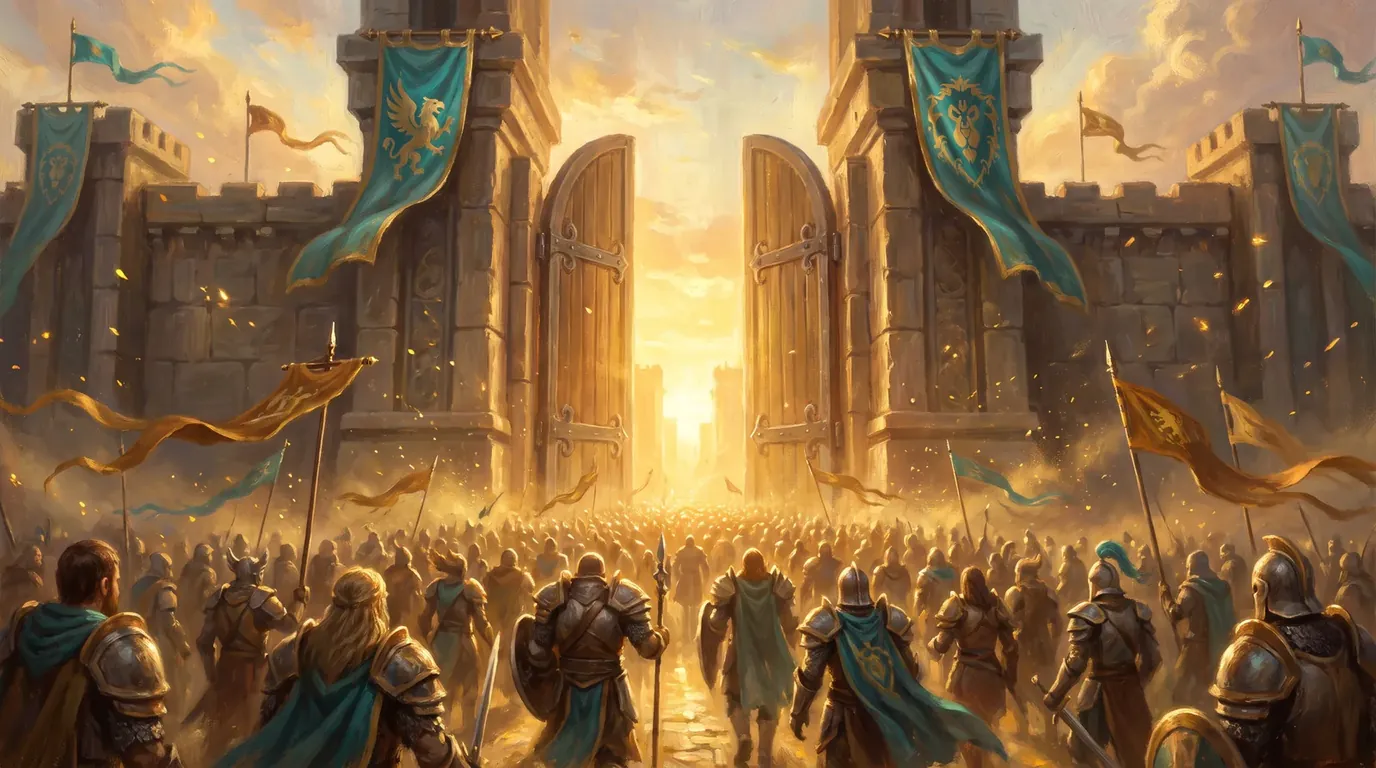
In Zarhold, your deck is your hero. It's a free, cross-platform MMORPG where every hero has a deck of ability cards instead of an action bar, and combat is turn-based, in the browser on computer or phone, with friends in the same party. You don't build the deck from a collection, as in card games, and you don't rebuild it every run, as in roguelikes: your class, talents, specialisations and gear shape it over years. Below we walk through how that works step by step and compare it with other online games where you build a deck together.
Three ways to build a deck
Card games build decks in different ways, and that choice defines the whole game.
- From a collection. As in collectible card games: you gather cards and decide which thirty to take into battle.
- During a run. As in roguelikes like Slay the Spire: you start with a simple deck and add cards after each fight, and death sends you back to the start.
- Through your hero's growth. As in Zarhold: the deck grows with your hero and stays with them for good. The decisions happen in talents, specialisation and gear rather than before every fight.
The third way is closer to a classic RPG: you're not shuffling thirty cards, you're growing a hero, and the deck reflects that growth. For a closer comparison with roguelikes, see games like Slay the Spire.
What a Zarhold deck is made of
Class cards
Each of the 10 classes has 20 to 24 cards of its own, all available from level 1. A deck is never smaller than 30 cards: the gap is filled with copies of the cheapest ones, and no card appears more than four times. That keeps your opening hand smoother. You can browse every class's cards in advance in the Spellbook on the website; in the game it opens with the P key.
Talents: the main lever
Talents unlock at level 10, you have 51 points by level 60, and each class has three trees. This is where the real deckbuilding happens:
- each class has 3 to 6 talents that add a new card to your deck, at least one in every tree;
- other talents strengthen specific cards or make them cheaper (but never below one crystal);
- a tree's capstone opens at 20 points in that tree (15 for the Dawnbearer), and a loadout can hold only one.
Points go freely into any tree and respecs are always free, so you can experiment as much as you like. More on the trees: Talents in a card RPG.
Two specialisations and loadouts
From level 20 your hero has two specialisations, each with its own talents and therefore its own deck: say, a damage spec for questing and a healing spec for dungeons. On top of that you can save up to three talent loadouts and switch with one button outside combat.
Healer cards
The only cards you place in the deck by hand. Each of the five healing trees has three cards of its own: in the Spellbook, the "Add to deck" button adds two copies in place of your two most expensive attack cards. They work in party fights against creatures; in PvP your deck stays as it was.
Special cards
A handful of epic and legendary cards outside the classes come from major achievements and the Battle Pass. Each goes into your deck as a single copy.
How the deck changes as you play
To make it concrete, here's one hero's path in broad strokes:
- Level 1. The deck holds every class card, topped up to 30 with copies of the cheap ones. You can already play combos.
- Level 10. Your first talent point and a choice of direction: tank, healer or damage, if your class can do it.
- Levels 15 to 30. Talent cards arrive: each tree has its own, and which ones you get depends on the trees you choose.
- Level 20. A second specialisation, and with it a second deck for another role.
- Level 60. 51 points, one tree's capstone, and from there growth comes through gear: every new item raises your main stat and strengthens every card at once.
How gear strengthens your cards
Gear doesn't add cards; it strengthens all of them at once through your main stat. Gear and talents provide it, and the maths is simple: a card's number equals its base plus your main stat multiplied by (card cost / 5) to the power of 1.2. A 5-crystal card gets your whole main stat, cheaper cards get less and expensive ones more. Cards that hit several targets get half the bonus per target.
That gives you a simple building rule: the more expensive cards in your deck, the more every new piece of gear pays off. Class armour sets such as Tier 1 add bonuses tied to your active talent tree, though those bonuses don't apply in PvP.
Online deckbuilding games compared
| Game | How the deck comes together | Playing with friends | What carries over | Price |
|---|---|---|---|---|
| Zarhold | class cards, talents, specs, gear strengthens cards | parties of up to 5, raids, arena, guilds | a permanent hero, no wipes | free |
| Wizard101 | you build your spell deck yourself and change it before fights | an MMORPG with solo and team battles | your hero and card collection | free, some areas paid |
| Across the Obelisk | the party's decks grow during an expedition | online co-op for up to four | each expedition starts over | paid |
| Slay the Spire 2 | the deck is drafted during the run | online co-op for up to four | each run starts over | paid, early access |
Wizard101 is the closest to Zarhold in format: it's also an MMORPG with turn-based spell-card battles, except there you build your deck from a collection and change it before fights, and the game installs as a client on Windows and Mac. Across the Obelisk and Slay the Spire 2 offer co-op for up to four players, but they're roguelikes: the deck is rebuilt every run. Zarhold is the only one of these where the deck lives with your hero for years and you can play right in the browser.
What it adds up to in combat
All of this comes together in a turn-based duel: you hold 6 cards, draw one each turn, and two per turn from turn 10. Crystals grow from one to ten, and unspent ones are lost. You get a minute per turn. In a party, everyone controls their own hero with their own deck: the tank holds enemies with a taunt, the healer heals and shields, and the damage dealers strike. How to read a card and what a crystal's colour means is covered in Card MMORPGs: what they are, and how Zarhold differs from collectible card games in Card RPG online.
How to start
- Open the game page in a browser on your computer or phone, or type zarhold.com/play.
- Press "Play without signing up" and pick a class: it decides your deck. Browse the Spellbook first if you'd like to choose by cards.
- At level 10, open your talents and spend your first point: that's step one of your build. To keep your hero, link an email in the "Save your hero" window at level 5.
You can play one hero on any device, as the cross-platform MMORPG page explains, and the hub page browser MMORPG covers the no-install format.
Frequently asked questions
Can I build my own deck in Zarhold?
Not from a collection. Your deck assembles itself from class cards, the cards of talents you've learned and special cards, and you shape it through talents, specialisation and gear. Only healer cards are placed by hand.
Can I remove a card from my deck?
No. Every card your hero has goes into battle. The exception is healer cards: you can put them in place of attack cards and take them out again.
How does gear affect my cards?
Gear raises your main stat, which adds to the damage, healing and shields of every card. A 5-crystal card gets your whole main stat, cheaper ones less, expensive ones more.
Can I play with friends?
Yes. Parties of up to five heroes, dungeons for three, raids and world bosses for five, and an arena in 2v2, 3v3 and 5v5. Everyone controls their own hero with their own deck.
How much does a talent respec cost?
Nothing: respecs are always free. And from level 20 you can keep two specialisations, each with its own deck.
Is Zarhold free?
Yes. You can play for free, and gameplay advantage isn't for sale. The only thing with a practical benefit is the Battle Pass: its heirloom items speed up PvE levelling a little. Other games are mentioned here for comparison only; Zarhold isn't affiliated with their owners.
- Games like Slay the Spire, but MMORPG: ZarholdRoguelike deckbuilders like Slay the Spire, and an MMORPG built on a deck
- Zarhold: a free browser MMORPG to play in any tabWhat a browser MMORPG is, how to choose one and what Zarhold offers
- Cross-Platform MMORPG with Cross Progression: ZarholdOne hero on PC, Mac, phone and tablet, and how it works
- Mobile MMORPG for Android, iPhone and iPad: ZarholdHow to play an MMORPG on Android, iPhone and iPad in the browser
- Games like RuneScape and OSRS: Zarhold and moreWhy people love RuneScape and OSRS, and what to play if you want something similar
Further reading on the blog
- Talents in a card RPG: the tree, specialisations and a build for every role
- The Spellbook: every card of every class, in the game and on the site
- Card MMORPGs: what they are and why a deck beats a hotbar
- Card RPG online for free: a hero, a deck and real players
- Tier sets in an MMORPG: Tier 1 class armor sets, regalia and set bonuses