The Spellbook: every card of every class, in the game and on the site
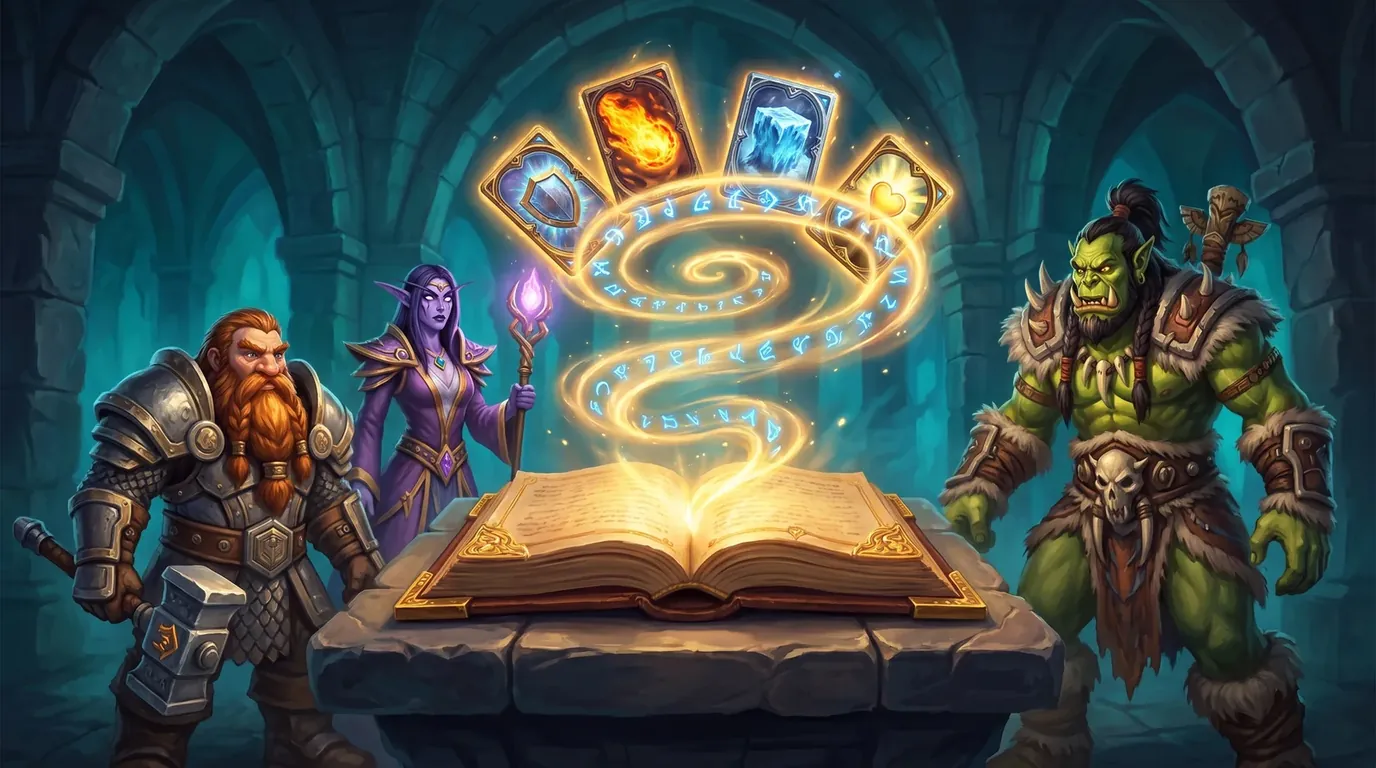
Zarhold’s Spellbook: every class card in the game and on the site — cost, role, full text, talent cards, how to read a card and how your deck is built.
The Spellbook is the full list of your class cards: everything that can end up in your hand, with its cost, role and full text. In a card RPG your class spells are your deck, so the Spellbook is the fastest way to understand a class before you’ve played a single fight with it. In Zarhold you can open it both in the game and on the website — no login, no sign-up.
Let’s look at what the Spellbook shows, how many cards each of the ten classes has, how to read a card and how to use the book to pick a class and plan your talents. If you’re new to card combat, start with “Card MMORPGs: what they are”.
Where to open the Spellbook
In the game, press P or the “Spellbook” button on the bottom bar. It’s a tome with ribbon bookmarks: you turn the pages, and the book fits your screen — phone, tablet or ultrawide monitor — in one piece, with no scrolling. The in-game book knows your hero: it shows which cards are already in your deck and how many copies there are, and it calculates the card text with your own numbers.
On the website, the same book lives in the knowledge base: every class on one page, plus a page for each class — for example, the Warlock’s book or the Mage’s book. The cards aren’t copied by hand: the page builds the book from the game’s own catalog with the same code, so the cards and their text match. There’s one difference — on the site the numbers are shown without Power, as base values. In the game they grow along with your hero’s gear.
How many cards each class has
Every class has cards of its own — these are always in the deck — plus cards that come from talents. Here are the current numbers:
- Barbarian — 24: 21 class cards and 3 from talents;
- Lightbringer — 26: 23 and 3;
- Ranger — 25: 22 and 3;
- Rogue — 24: 21 and 3;
- Priest — 24: 21 and 3;
- Revenant — 26: 22 and 4;
- Stormbringer — 26: 22 and 4;
- Mage — 23: 20 and 3;
- Warlock — 30: 24 and 6;
- Druid — 27: 22 and 5.
That’s 218 class cards and 37 talent cards in total. On top of that, every class’s book has two more tabs shared by everyone: eight legendary relics that belong to no class, and 22 racial abilities — two for each of the eleven races.
Class cards cost 1 to 8 crystals, and the cost curve looks similar for every class. The most common cost is 3 — that’s 74 cards out of 218, one in three. Almost eight cards in ten cost less than 5 crystals, while only 13 cards across all classes cost 6 or more: those are your trump cards, usually played around the middle of a fight. The Lightbringer and the Priest have no 1-crystal cards — their cheapest ones cost 2.
By rarity, class cards are common (103), rare (98) or epic (17). Rarity doesn’t change the rules of combat: a card’s strength comes from its cost and your Power.
Five bookmarks: what’s inside
The title page shows how many cards each section holds and how many of them you already have. The sections are the ribbon bookmarks:
- Class — your base cards. They’re always in your deck, and each card shows its number of copies, such as “×2”.
- Talents — the talent cards of all three trees, collected or not. A card you don’t have yet tells you how to get it: the tree number, the row, how many points you need in that tree and from which level that’s possible.
- Legendary — eight relics outside any class. You get them for feats and in the Battle Pass; each one goes into your deck as a single copy and works both against creatures and in PvP.
- Racial — every race’s abilities shown as cards: cost, effect, cooldown. They don’t go into your deck: they’re a separate combat button, with one version for fights against creatures and another for PvP.
- All — the whole book at once.
How to read a card in the book
A card in the book looks exactly like it does in your hand during a fight. Learn to read the book and you can read your hand.
- The crystal in the top-left corner. Its number is the cost in crystals. Its colour is the card’s role: red — damage, green — healing, gold — shield and defence, purple — buffs and control. If a card has two roles, the gem is two-coloured, and the icon in its corner shows the main one.
- The card type — Attack, Spell, Heal, Buff or Trick. It’s a label, not a role: the role comes from what the card actually does. More on the colours in “How to read a card”.
- The text — what the card does and with which numbers. Tap a card and it flips from its back to its face and opens up close, with the full “Card description” right next to it. That’s especially handy on a phone, where long text on the card itself gets small.
- “How to get” — on every card you don’t own yet.
A card’s damage, healing and shield all grow with Power by the same rule: base + Power × (cost / 5)^1.2. A 5-crystal card gets all of your Power, a 1-crystal card about 15% of it, and an 8-crystal card 176%. So the better your gear, the further expensive cards pull ahead of cheap ones. Every effect — area damage, DoTs, stuns, dispels — is covered in “Card effects”.
Filters, search and card order
With close to a hundred cards in the book, flipping through page by page gets tedious. That’s why the book has:
- cost — crystal buttons from 0 to “10+”, and you can pick several at once;
- role — the same four colours as on the crystal;
- card type and talent tree;
- collected — all, collected or missing (in the game);
- order — by cost, by role, by name, and in the game also “Collected first”;
- search by name and text.
Text search is the book’s most underrated tool. Open the “All” tab, type “stun”, “poison” or “shield” and you’ll see every card with that effect: class cards, talent cards, relics and racials alike.
Your class deck: what it’s made of
In Zarhold you don’t build a deck by hand the way you would in a collectible card game. Everything you have goes into the fight:
- every class card — from level 1; class cards don’t unlock by level;
- if you have fewer than 30 cards of your own, the deck is topped up with copies — the cheapest first, up to 3 crystals; no card can have more than 4 copies;
- one copy of every talent card whose talent is learned in your active specialisation;
- one copy of every relic you own.
Right now every class has a core deck of exactly 30 cards, with the cheap cards in it doubled. The Mage, with 20 cards, gets ten cheap cards doubled; the Warlock, with 24, gets six. Hence a simple rule: the fewer cards a class has, the more often your hands repeat; the more it has, the more varied your fights.
Copies make a real difference to your opening hand. You start a fight with six cards out of thirty: a card with one copy lands in those six about one fight in five, while a card with two copies shows up in more than a third of your fights. That’s why cheap cards carry your first turns, while expensive ones arrive less often and get played later.
In PvP your deck isn’t reshuffled: once you run out of cards, fatigue damage kicks in. The full deck rules are in “Your deck”.
Choosing a class with the Spellbook
The website book is open to everyone, so you can study a class before you even create a hero.
- Look at the crystal colours. Lots of red — a damage class. Lots of green and gold — healing and protection. Lots of purple — control and buffs. Hybrids mix their colours, and you can see it at a glance.
- Look at the cost curve. Plenty of 1–3 crystal cards means quick early turns. A few 6–8 crystal cards are the big plays worth surviving until mid-fight for.
- Compare variety. The Warlock has 30 cards — the most varied book in the game. The Mage has 23 — fewer cards, but each one turns up in your hand more often.
- Open “Talents”. It shows what the class gets later and at which level. The earliest talent cards come at level 15, for the Druid and the Stormbringer. The Lightbringer, Ranger, Priest and Mage open all their talent cards from level 20, the Barbarian from 25, and all six of the Warlock’s sit in the last row of its trees, available from level 30.
- Open “Racial”. When you pick a race, you get its two abilities — one for fights against creatures and one for PvP. Each costs 1 to 3 crystals and goes on a 3–5 turn cooldown.
We covered every class’s roles, armour and Health in “Which class to choose”, and there’s a summary table of all classes in the Classes by the numbers reference.
Planning your talents with the Spellbook
Talents unlock at level 10, and the Spellbook is the best tool for planning them.
- A talent card tells you where it lives. Each one shows its tree number, its row, how many points you need in that tree and from which level that’s possible. Your first point arrives at level 10, then one per level, and rows open for every 5 points in a tree.
- In the game, a class card shows which talents improve it. The close-up view has a line saying “Talents of the … branch improve this card”. Find your favourite cards and you instantly see which tree works with them.
- The tree also decides your Class Power. The tree with the most points becomes your specialisation and sets your Class Power — more in “Class Power and Racial ability”.
- Check the result. Learn a talent and its card joins your deck right away, and the book marks it “Talent learned — the card is in your deck”. The “Missing” filter shows what’s left.
A talent card stays in your deck only while its talent is learned in your active specialisation: switch to the other one and your deck changes. How trees, top talents and loadouts work is covered in our article “Talents in a card RPG” and in the knowledge base — “How talents work”.
Spellbook FAQ
Do I need to log in to see all of a class’s cards?
No. Every class’s Spellbook is open on the website, in the knowledge base — no login and no sign-up. The cards are the same as in the game; only the numbers are shown without Power.
Why are the numbers on the website lower than in the game?
On the website cards are shown with their base numbers, without Power. In the game the text is calculated with your hero’s Power, and the more a card costs, the bigger the share of Power it gets.
Do class cards unlock as I level up?
No, every class card is available from level 1 and always sits in your deck. Levels only unlock talent cards — from level 15 to 30, depending on the row — while relics come from feats and the Battle Pass.
Can I remove a card from my deck or add another class’s card?
No. Every class card, the cards of your learned talents and your relics all go into the fight. You shape your deck through talents and your choice of specialisation.
How many cards are in a class deck?
Every class has a core deck of 30 cards: anything short of thirty is filled with copies of cheap cards. On top of that come one copy of each learned talent card in your active specialisation and one copy of each relic you own.
The bottom line
The Spellbook is a reference, a guide to choosing a class and a plan for your future talents all in one. Open the book on the website, compare classes by colour and cost, find the cards you love and see which tree improves them. Then create a hero and test the deck in a real fight — it’s free and runs right in your browser.
Read next
Card MMORPGs: what they are and why a deck beats a hotbar
What makes a card MMORPG different and why a deck beats a button rotation — explained through Zarhold: your hand, crystals, talents and ten classes.
Talents in a card RPG: the tree, specialisations and a build for every role
The talent tree in Zarhold: 51 points by level 60, rows and top talents, two specialisations, loadouts and how to build for solo, groups and the arena.
Which class to choose: tank, healer or damage dealer in a card MMORPG
Which class to choose in the card MMORPG Zarhold: what tanks, healers and DPS do, how the 10 classes differ, their armour and Health, talents and races.