Talents in a card RPG: the tree, specialisations and a build for every role
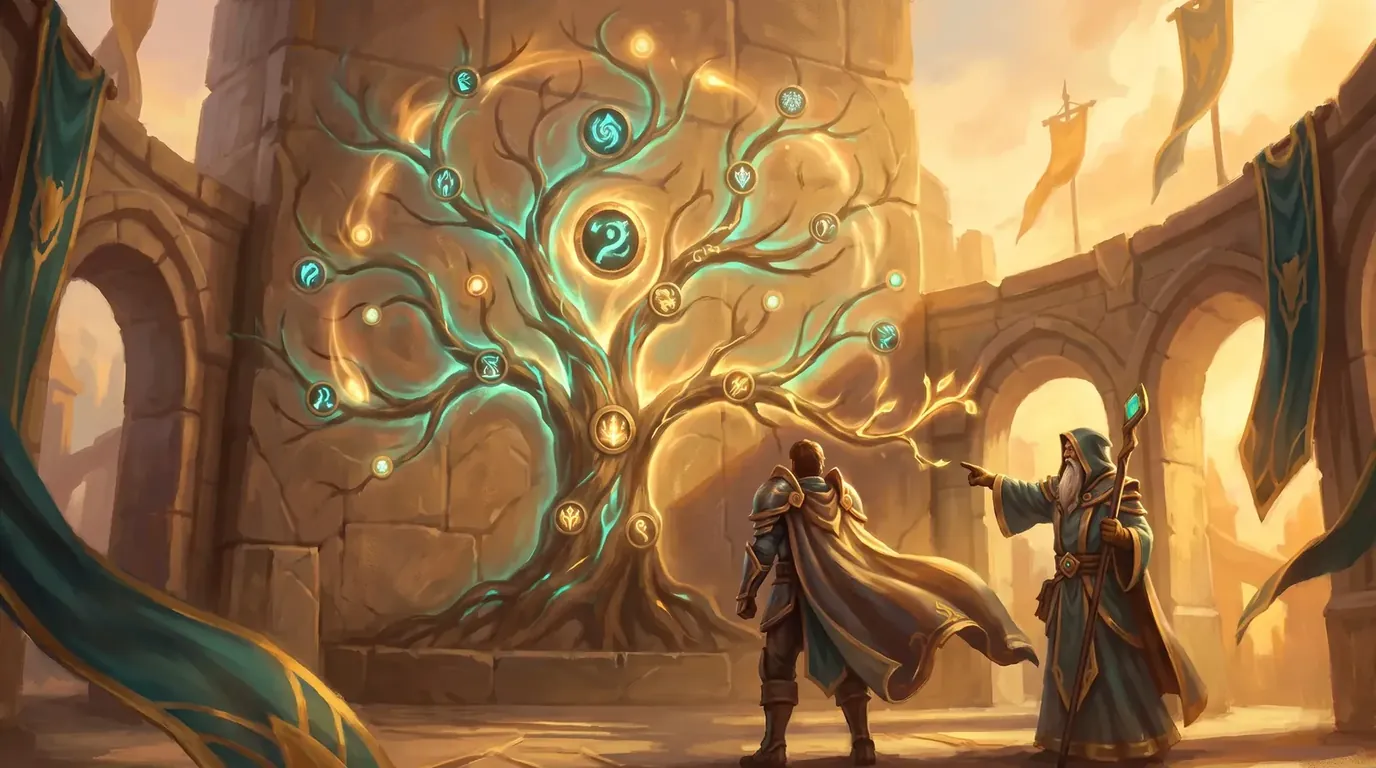
The talent tree in Zarhold: 51 points by level 60, rows and top talents, two specialisations, loadouts and how to build for solo, groups and the arena.
The talent tree is what turns a class into your hero. In a card RPG talents change more than numbers — they change the deck itself: they add new cards, strengthen and discount old ones and decide which Class Power you get. Two heroes of the same class with different talents can play like two different classes.
Let’s look at how talents work in Zarhold — trees and rows, points and top talents, two specialisations and loadouts — and how to put together a build for solo play, groups and the arena. If you haven’t picked a class yet, start with “Which class to choose”.
How the talent tree works
Every class has three talent trees. Talents in a tree are arranged in rows: nine classes have five rows, the Lightbringer has four. A single tree holds 9 to 14 talents, and the game has 326 talents across 30 trees. Every point you spend is one rank of a talent: some talents have a single rank, others several.
The trees map to roles:
- Barbarian — two damage trees and a defence tree;
- Revenant — a defence tree and two damage trees;
- Lightbringer — healing, defence and damage trees;
- Druid — defence, damage and healing trees;
- Stormbringer — two damage trees and a healing tree;
- Priest — two trees for healing and protecting allies, plus a damage tree;
- Ranger, Rogue, Mage and Warlock — three damage trees each, every one dealing damage its own way.
Every class’s trees, with talent and rank counts, are in the Talent trees reference. In the game, the talent screen opens with the N key.
Talent points: how many and when
Talents unlock at level 10: at that moment the game invites you to pick a path, but the choice doesn’t lock you in. From there it’s simple:
- your first point arrives at level 10, then one per level: at level L you have L − 9 points, 11 at level 20 and 51 at level 60;
- the next row of a tree opens for every 5 points spent in that tree: the second row after 5, the third after 10, the fourth after 15, the fifth after 20;
- so the earliest level for the second row is 15, for the third 20, for the fourth 25 and for the fifth 30;
- you can spend points in any trees, in any combination: trees don’t lock each other.
On a computer, left-click spends a point and right-click takes it back. You can read a talent before learning it: hover over it or tap it and all its ranks open up, with the current one highlighted. The numbers on a rank are the total at that rank — they don’t stack with the previous one.
You can’t learn everything. Almost every class has far more ranks across its trees than 51 points: the Barbarian has 116, the Warlock 91, the Mage 68. That’s exactly why talents are a choice — and the sum of your choices is your build.
The top talent
The top talent is the final talent of a tree, with a single rank. It opens once you’ve spent 20 points in its tree — 15 for the Lightbringer. The earliest you can take it is level 30, or level 25 for the Lightbringer.
A hero can hold only one top talent per loadout. You can’t take the top talents of two trees at once — the second one can only live in your other specialisation. Many top talents change how their tree plays, adding a rule of their own rather than just bigger numbers.
What talents give you
- Bonuses to Health, Power and defence.
- Boosts to specific cards and discounts on their cost. The discount comes with a talent’s last ranks, and a paid card never drops below 1 crystal.
- New cards for your deck — every class has 3 to 6 such talents, at least one in each tree. The card arrives with the very first rank, and these talents sit in rows that open between levels 15 and 30.
- Effects that trigger in combat on their own.
There are no empty ranks: if a rank adds nothing over the previous one, it gives +1% Power instead. Talents work the same way against creatures and in PvP.
Which cards your class’s talents bring, from which level and in which tree, is all in the Spellbook — see our article “The Spellbook” — and every class’s cards are on the website, no login needed, in the Spellbook. How talent cards end up in a fight is covered in “Your deck”.
Specialisation: the tree that decides your Class Power
Your specialisation is your main tree. By default it’s simply the tree with the most points in it. You can also lock in a tree by hand — with the “Activate” button in its header, as long as it has at least one point.
Your specialisation decides three things.
- Your Class Power — the round button that costs 1 crystal and can be used once per turn. Tank trees get Taunt, healing trees a healing power you can aim at an ally, and the rest an attacking power. Until level 10 everyone’s power attacks.
- Talent cards in your deck — only cards of talents learned in your active specialisation go into the fight.
- Tier 1 set bonuses — they also depend on the tree you’re currently playing. More in “Tier 1 — Regalia and the Forge”.
The tree changes the Class Power differently from class to class. The Ranger, Rogue and Warlock have the same power in all three trees — picking a tree changes talents and cards, not the button. The Mage is the opposite: each tree gives its own attacking power. The Barbarian and Revenant get Taunt only in their defence tree. The healing powers of the Lightbringer, Stormbringer and Druid can also hit an enemy, while the Priest’s only heals and protects. Every power by tree is listed in the Class Power reference.
Two specialisations and loadouts
From level 20 your hero has two specialisations — Spec A and Spec B. They’re two independent sets of talents, each with its own top talent and its own deck. You switch between them with one button on the talent screen, outside combat, and the effects change instantly.
A loadout is a saved snapshot of your talent tree. A hero can keep up to three:
- Press “Save loadout”, give it a name of up to 24 characters and pick an icon — one of the talents of your main tree.
- To bring a loadout back, pick it and press “Apply”: it goes into your active specialisation in one tap.
- In the same place: “Update”, “Rename” and “Remove”.
You can’t save an empty loadout, and one only applies if your level gives you enough points. Switching specialisations, applying loadouts and resetting talents are all free, so you can experiment as much as you like. Details in “Specialisations and loadouts”.
Putting a build together: solo, group, arena
A build answers one question: what is this hero for? Start there and place the points afterwards.
The point maths
At level 60 you have 51 points. A handy way to think about it: 21 points in your main tree — 20 to reach the top talent plus the top talent itself — and 30 points for everything else (the Lightbringer’s top talent is closer: 16 and 35). For example, 20 points in a second tree reach down to its fourth row, and the last 10 in the third tree cover its first two rows. You can split it differently, too: collect the Health and Power bonuses from the first rows of every tree, or reach a talent card you want in a neighbouring tree.
Solo play
For open-world quests, a tree whose Class Power hits enemies is the comfortable choice. For damage dealers that’s any tree. The Lightbringer, Stormbringer and Druid have healing powers that also deal damage, so their healing trees work solo too. The Priest is better off questing in the damage tree. Take the Health and Power bonuses and your tree’s talent cards — until level 20 you only have one specialisation.
Groups
You pick your dungeon queue role yourself from your class’s roles, but your talents have to match it. A boss attacks whoever has dealt it the most damage, and only a tank with Taunt can pull it away: in a party fighting creatures, enemies attack you immediately and for their next two turns, their damage to you drops by 40%, and you can taunt again 3 turns later. A healer needs a healing tree — their power can be aimed at an ally. A dungeon takes a tank, a healer and a damage dealer; a raid or a world boss takes a tank, a healer and three damage dealers. Details in “Group roles”.
The arena
Talents work in PvP exactly as they do against creatures, but the fight itself has its own rules. Taunt doesn’t hold opponents and only gives armour. From your 10th turn, healing and shields weaken by 10% per turn, your third and later heals in a turn are halved, and a shield from a card lasts two turns and can’t exceed 30% of your Health. Your deck isn’t reshuffled — run out of cards and fatigue sets in. Tier 1 set bonuses don’t work in PvP. That’s why players usually keep a separate specialisation for the arena. All the rules are in “Special rules of PvP combat”, and the arena modes are covered in our article “PvP in a card game”.
Mapping it all to buttons
A typical setup at level 60: Spec A for quests and solo play, Spec B for your group role, and three loadouts for the usual cases — dungeon, raid, arena. Switch outside combat and your hero is ready for something else.
Talents FAQ
At what level do talents unlock, and how many points are there?
At level 10: the first point comes at level 10, then one per level. At level L a hero has L − 9 points, 51 by level 60.
Can I take the top talents of two trees?
Not in one loadout: a hero gets one top talent. You can keep another tree’s top talent in your second specialisation, which opens at level 20.
How much does a talent reset cost?
Nothing. Resetting talents, switching specialisations and applying loadouts are always free.
Why did my Class Power change?
You moved your points around and a different tree became your main one: your Class Power always follows your specialisation. To lock in the tree you want, press “Activate” in its header.
Do talents work the same in PvP as in PvE?
Yes, talents and their triggers are the same everywhere. What changes are the rules of the fight itself: Taunt only gives armour in PvP, healing and shields weaken over time, and Tier 1 set bonuses don’t apply.
How is a loadout different from the second specialisation?
There are two specialisations, and both are always at hand — one button switches between them. A loadout is a spare snapshot of your tree: you can apply it to either specialisation whenever you need it.
The bottom line
A good build starts with one question: where will you play most — solo, in a group or in the arena? Pick a main tree for that role, take it to its top talent, spend the rest on whatever supports your deck, and keep your second specialisation and loadouts for everything else. Resets are free, so mistakes cost nothing. Start playing — your first talent point is waiting at level 10.
Read next
Which class to choose: tank, healer or damage dealer in a card MMORPG
Which class to choose in the card MMORPG Zarhold: what tanks, healers and DPS do, how the 10 classes differ, their armour and Health, talents and races.
The Spellbook: every card of every class, in the game and on the site
Zarhold’s Spellbook: every class card in the game and on the site — cost, role, full text, talent cards, how to read a card and how your deck is built.
Tier sets in an MMORPG: Tier 1 class armor sets, regalia and set bonuses
What a tier set is in an MMORPG and how Tier 1 works in Zarhold: 10 class armor sets, regalia from heroic raids, the Regalia Forge and 2/4/6/8 set bonuses.