MMORPG auction house: how to sell items, trade with players and make gold
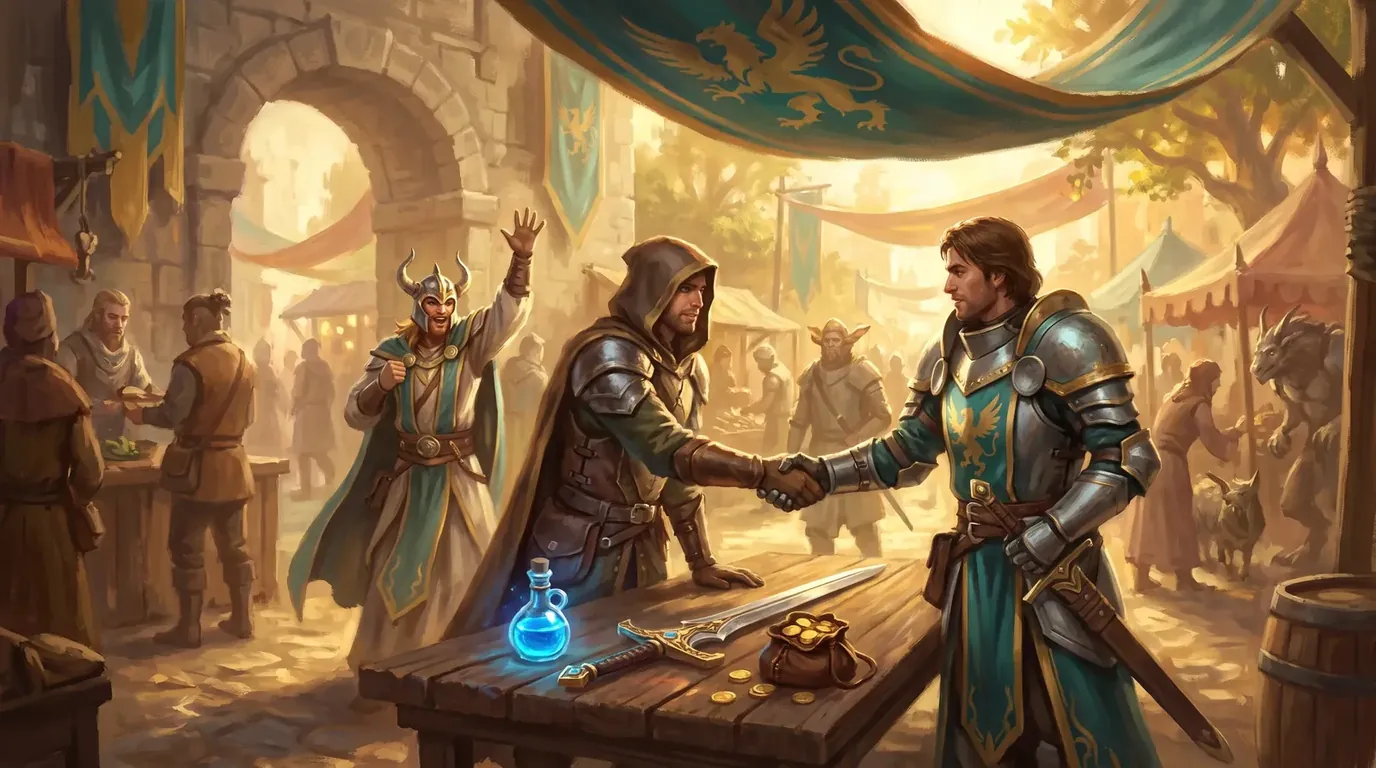
The auction house in the MMORPG Zarhold: listing and buying lots, deposit and fee, stacks of 20, what can’t be sold, mail, trade and how to make gold.
The auction house is the heart of an MMORPG economy. Gatherers sell ore and herbs there, crafters sell potions and gear, and everyone else buys what they can’t or won’t make themselves. In Zarhold the auction house is open from level 1, runs on buyout prices and sells your lots even while you’re offline.
Let’s look at how to sell items and buy what you need, what it costs, what you can’t list, how the merchant, mail and player-to-player trading help — and how to make gold from all of it. The professions that supply the market are covered in “MMORPG professions”.
MMORPG economy: money and auction rules
Money
The game has three coins: 100 copper make a silver, 100 silver make a gold. Amounts are written in short form: “1g 50s 12c” is one gold, 50 silver and 12 copper. Every hero has their own wallet.
Money comes from fights, quests, dungeons and raids, from the merchant and from other players. It goes on gear repairs, supplies, postage and the auction house: listing takes a deposit, and every sale pays a fee. These costs are small, but each deal takes a little gold out of circulation — that’s how most MMORPG economies work. More about coins in “Money”.
Auction house rules
There’s no bidding: the seller sets a price and the buyer takes the lot at once. Your lot sells even while you’re offline. There’s no limit on how many lots a hero can have.
- Duration — 48 hours.
- Deposit — 5 copper per lot. You get it back when the lot sells and lose it if you cancel or the lot expires.
- Fee — 5% of the price, rounded up to the copper, taken from your proceeds.
- Price — at least 5 copper and never below the merchant price for the whole lot; the ceiling is 10 million gold.
Example: a lot sells for 1 gold. The fee is 5 silver, so you receive 95 silver plus the 5 copper of your deposit. The full rules are in the knowledge base article “Auction House”.
How to list a lot
- Open the Auction House → the “List Item” tab. Items come from your bag or Hero Bank, stacks from your Pouch or Hero Bank.
- For a stack, choose how many pieces per lot — 1 to 20 — and how many lots. A lot is one stack, and a stack anywhere in the game holds at most 20. The “All” button lists everything you have, with the remainder as a separate lot: 205 fish become 10 lots of 20 plus one of 5.
- Set a price — per piece or per stack, whichever is easier. The window shows how much of it you have (and how much is in your Hero Bank), what’s at the auction now — lots, pieces, the lowest and the usual price per piece, not counting your own lots — and the total before you press anything: per piece, for everything, the deposit and what you’ll receive after the sale.
- Press “List Item” or Enter. The price is remembered for next time.
There are three quick price buttons:
- “Market price” — the usual market price: the middle, with half the lots cheaper and half more expensive;
- “Undercut” — 1 copper per piece below the cheapest lot, so yours sells first;
- “Last price” — the same as your previous sale.
None of them will push the price below the merchant’s. And if you set less than half the usual price or more than twice it, the window warns you — so a typo never reaches the market. Identical crafted items are listed through the same window, each as its own lot.
How to buy at the auction house
On the “Buy” tab identical items are grouped into one row showing the number of lots and the best price. The “Buy” button takes exactly the lot shown; if someone has already bought it, the list refreshes on its own. Your own lots aren’t shown here and don’t count towards prices. A name search and filters help you find things: quality, armour class, one- or two-handed weapon, accessory type, level, price and profession.
Materials and consumables can be bought in any quantity you need: type the amount and you see the total before you buy. The game takes whole lots, starting with the cheapest, and never spends more than the total shown. Everything arrives by mail in a single “Auction purchase” letter.
Gear of green quality and above becomes soulbound the moment it reaches you. The exception is crafted gear: until someone equips it, it can be resold; once equipped, it becomes soulbound. Think about that before you try something on.
Auction letters, “My Auctions” and “My Sales”
- The “Lot sold” letter — the subject shows what sold and how many pieces, and the text gives the price per piece, the total, the fee, the returned deposit and what you received. Letters are kept for 30 days, and auction letters are not returned when they expire — collect your money in time.
- “My Auctions” — all of your lots. Identical lots are grouped into one row, and you can take them all down at once after confirming. A lot that doesn’t sell in 48 hours leaves the market but stays here: “Cancel” brings the item back; the deposit doesn’t come back.
- “My Sales” — your history: what sold, how many pieces, the price each and when, with a search and a weekly total. A “List again” button appears if you have the same item.
- “Sold this week” — materials and consumables show how many sold over the last 7 days and the average price per piece, as long as there were at least three sales.
What you can’t sell at the auction house
The main rule is soulbound items. All gear of green quality and above becomes personal as soon as it reaches your hero, wherever it came from. Its card says “Soulbound”. You can equip it, sell it to the merchant, disenchant it or keep it in your own Hero Bank, but you can’t list it, trade it or mail it. The exception is crafted gear: it says “Binds when equipped”, and until someone puts it on it can be sold and passed on. Details in “Personal items”.
You also can’t list:
- grey junk and white gear — sell those to the merchant;
- quest items and bags;
- heirloom, account-bound and unique (turquoise) items;
- items with “self only” enchantments and items granted by the administration;
- personal stacks.
On the other hand, any Pouch stack — materials, consumables, gadgets and recipe scrolls, even of white quality — can be listed freely. That’s what keeps the market going.
The merchant and buyback: when you don’t need the auction
The Merchant — the “Shop” button — takes almost everything, soulbound gear included. The only things he refuses are quest items, heirloom items, personal legendary relics and personal stacks. The price depends on rarity and level: for a level-60 item he pays 4 silver 5 copper for a green, 4 silver 90 copper for a blue, 2 gold for an epic and 5 gold for a legendary. Materials and consumables are bought per piece.
The merchant also sells 11 basic supplies — bandages, potions, food and reagents — plus bags with 8, 10 and 12 slots. He sells at 2.5 times what he pays, but instantly and in bulk: 1, 20, 100 or “Max” — up to 1,000 at once.
Sold the wrong thing? No problem: for a day it waits on the “↺ Buyback” tab, at the same price and as the very same item, enchantments and sharpening included. The merchant remembers your hero’s last 30 sales — more in “Merchant buyback”.
The merchant price is the auction house floor: you can’t list a lot any lower. But remember the fee: a lot priced exactly at the merchant price nets you 95% of it. If the market for something sits right at that floor, just sell it to the merchant: you get paid instantly, with no deposit or fee, and you can still change your mind for a day.
Mail, trading and the guild bank
The auction house isn’t the only way to trade with other players. Once you’ve found a buyer — in chat, in your guild or among friends — it’s easier to hand the item over directly.
- [Mail](/baza/ekonomika/pochta) delivers letters, money and items to any hero, even one who’s offline. A letter with attachments costs 1 silver no matter how much you attach: up to 12 attachments, a stack of up to 20 per attachment, and up to 1 million gold. A letter is kept for 30 days, and a player’s unclaimed letter goes back to the sender. You can’t write to yourself, but you can write to your other heroes.
- [Trade](/baza/ekonomika/obmen) is hand to hand, while you’re both online: up to 12 slots and up to 1 million gold per side. Both press “Ready”, then “Trade”, and any change to the offer clears “Ready” for both — nobody can swap an item at the last second.
- [The guild bank](/baza/soobshchestvo/bank-gildii) is your guild’s shared storage: gold, stacks and items that can be passed on. Guilds are covered in detail in “Guilds in an MMORPG”.
Soulbound items don’t go by mail, trade or into the guild bank. There’s one exception: an item you win in a roll in a group of live players can be traded for another 2 hours to a member of the same run who took part in the roll.
There are also duel stakes — up to 100 gold and up to 3 items per side, with 5% taken from the gold. But that’s a risk, not an income; the rules are in “Duels in an MMORPG”.
How to make gold: six ways
- Open-world enemies. A regular enemy of your level gives about 3 copper at level 1, 1 silver at level 20 and 75 silver at level 60. Packs pay 1.5 times as much, elites three times, land bosses six times. An enemy that’s green for you gives 60% of the copper, a grey one 35%, and repeat fights at the same spot pay 20% less each time, but never below a quarter. Switch spots and lands.
- Quests. All are one-time and pay copper on top of experience: from a few copper at the start to a few gold near level 60.
- Dungeons and raids. Everyone in the group gets the full copper reward. In a dungeon, your first clear in a day pays 100%, the second 50%, after that nothing. Raids and world bosses pay out everything on your first run of the day.
- Gathering. Every crafter needs ore, herbs, hides and fish. Gathering professions don’t take up a craft slot, and materials go to the auction house in stacks of 20.
- Crafting. Potions, bandages, enchantment scrolls, sharpening stones and crafted gear — things other players don’t make themselves. Potions and bombs work against creatures and in duels; bandages work everywhere.
- Disenchanting. A soulbound item you don’t need can’t be listed, but it can be disenchanted: a green one gives dust, a blue one an essence, a purple one several enchanting materials at once. And materials sell freely. Disenchanting needs Enchanting learned, at any skill level; a leatherworker can also break down leather and mail armour. Details in “Disenchanting and unravelling”.
The free track of the Battle Pass adds another 65 gold over 50 levels. Every method with its numbers is collected in “How to make gold”.
Pricing tips
- Look at “usual”, not just “from”. The cheapest lot can be a fluke, while the usual price — the middle of the market — shows what the item really sells for.
- Account for the fee. To receive a given amount, price about 5.3% higher: want 1 gold clear — list it for 1 gold 5 silver 27 copper.
- Check the history. “Sold this week” and “My Sales” show what people actually pay, and “Last time sold for …” reminds you of your own price.
- Don’t race to the floor. “Undercut” sells faster, but if the market is already at the merchant price, the shop is the better deal.
- Didn’t sell? Relist. The deposit is only 5 copper, so a lot that expires after 48 hours costs you almost nothing. Adjust the price and list it again.
- Don’t equip what you plan to sell. Crafted gear becomes soulbound once equipped, and it can never go back on the auction house.
How to gear up a hero for level 60 and which gear is worth buying is covered in “Level 60 gear”.
Auction house FAQ
How long does a lot stay on the auction house?
48 hours. If it doesn’t sell, it leaves the market but stays on the “My Auctions” tab: press “Cancel” and the item comes back. The deposit isn’t refunded.
What’s the auction house fee?
5% of the sale price, rounded up to the copper, plus a 5-copper deposit per lot. The deposit comes back with your proceeds if the lot sells.
Why can’t I list an item?
Most likely it’s soulbound: all gear of green quality and above binds to your hero when you get it. You also can’t list white gear, junk, bags, quest items, heirloom or unique items. Crafted gear can be listed until someone equips it.
Can I sell an item for less than the merchant pays?
No, a lot can’t cost less than the merchant price for the same item or less than 5 copper. If the market sits at that floor, it’s simpler to sell to the merchant — no deposit, no fee.
How do I send gold or an item to another player?
By mail — 1 silver per letter with any attachments, and the recipient can be offline. Or by trading hand to hand while you’re both in the game. Soulbound items can’t be passed on at all.
What’s the best thing for a new player to sell?
Materials. Gathering professions don’t take up a craft slot, every crafter needs ore, herbs, hides and fish, and you can list a stack of 20 from level 1.
The bottom line
Zarhold’s auction house is a fair buyout market: 48 hours, a 5-copper deposit and a 5% fee. Sell materials and crafted goods, disenchant soulbound gear you don’t need, check the usual price and the sales history — and the gold will pile up on its own. Jump into the game and list your first lot today.
Read next
MMORPG professions: crafting, gathering and how to make gold
Professions in the card MMORPG Zarhold: 12 professions, skill-ups by recipe colour, gathering, fishing, enchanting, the auction house and making gold.
Guilds in an MMORPG: how to create one, join one and run the guild bank
MMORPG guilds in Zarhold: how to create a guild for free and join one, five ranks and their rights, chat, the gold and item bank and how to pick a guild.
Level 60 gear guide: how to gear up your hero and raise your item level
How to gear up at level 60 in Zarhold: what item level (ilvl) means, where to get 200, 226 and 232 gear, enchants, sharpening and the way to the best gear.