Co-op MMORPG: a live party where everyone plays their own hero
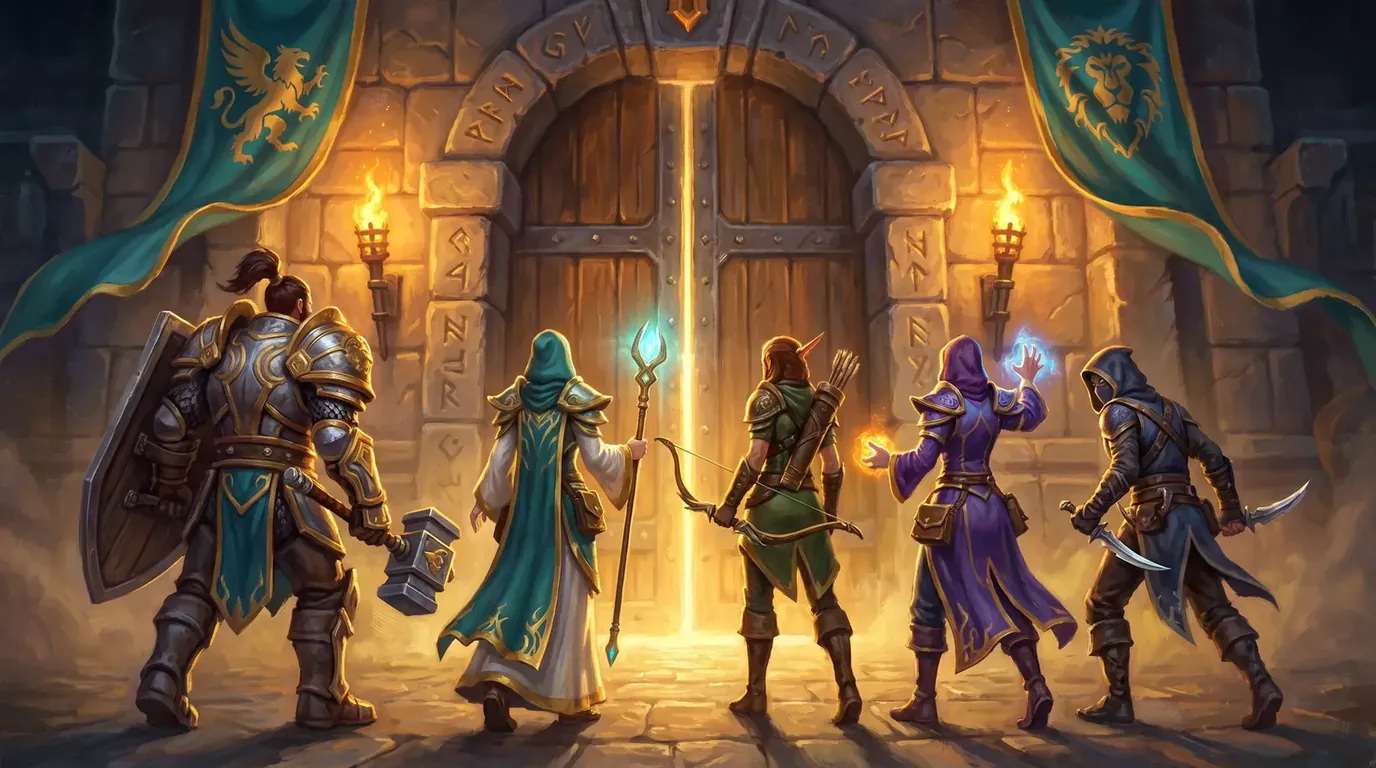
A co-op MMORPG in your browser: a live party of up to 5 heroes, shared turns on one board, roles, a ready check, loot rolls, raids and heroic in Zarhold.
What makes a co-op MMORPG worth playing isn’t how many people share the server — it’s whether you actually play together: everyone holding their own hand, counting their own crystals and covering a teammate at the right moment. In Zarhold, a browser-based card MMO-RPG, that’s exactly how co-op works: in a live party every player plays their own hero, on one shared board, against a common enemy.
We’ve already covered friends, chat, duels and trading in “MMORPG with friends”. This article is all about the fight itself: how to put a group together for dungeons, what the ready check does, how the party takes its turns, what happens when a teammate drops, and how loot is shared.
What co-op means in Zarhold
A live party is up to 5 players’ heroes. In combat everyone plays their own hero: their own cards, Class Power, racial ability and consumables. Nobody plays for anyone else — not the leader, not anybody.
You can play together online almost anywhere there’s a group fight:
- dungeons — from level 10, a party of three;
- raids and world bosses — at level 60, a party of five;
- the team arena at 2v2, 3v3 and 5v5;
- the battleground at 5v5.
In PvE you take on bosses and their entourage together; in PvP you face another team. For the arena and battlegrounds a live party first spends 45 seconds looking for a live enemy party of a suitable level, and only if none turns up does it fight world residents.
How to form a party
Party play starts with an invite. Invite a player by name or through the name menu in chat — the first invite creates the party. You can even invite someone who’s offline: the invite will wait until they log in.
- The party has a leader: they queue the party, pick the next fight during a run, and can pass on the lead, remove a member or disband the party. If the leader leaves, the party breaks up.
- Accepting a new invite takes you out of your old party.
- A party can only go where there are at least as many seats as heroes: five of you won’t fit into a three-seat dungeon or a 3v3 arena, and three won’t fit into a 2v2.
Where to find people: friends, World chat and, of course, a guild — more on that in “Guilds in an MMORPG”.
Roles: tank, healer, damage dealer
A dungeon takes three — a tank, a healer and a damage dealer; a raid or world boss takes five — a tank, a healer and three damage dealers. Which roles your class can take:
- Lightbringer and Druid — any of the three;
- Barbarian and Revenant — tank or damage dealer;
- Priest and Stormbringer — healer or damage dealer;
- Mage, Warlock, Ranger and Rogue — damage dealer only.
You pick your role with the 🛡, 💚 and ⚔ buttons on the Dungeons screen — only your class’s roles are shown. But a role is a promise to your party: a tank needs a tank specialization with Taunt, a healer needs a healing one. And check your line-up in advance: a Mage and a Warlock can’t go into a dungeon as a pair — there’s only one damage dealer seat.
In combat, roles work through threat. An enemy attacks whoever has dealt it the most direct damage, and the tank’s Taunt immediately pulls every hit onto the tank for 2 enemy turns, while cutting the damage the tank takes by 40%. Healers aim their heals with hotkeys: F1 for yourself, F2–F5 for allies. More in “Group roles”.
The ready check: everyone goes or nobody does
When the leader calls the party into a dungeon, the arena or a battleground, everyone gets a window for 30 seconds: Ready (with a role choice for dungeons) or Decline. The window shows where you’re heading, in which mode, and who has already answered.
It’s everyone or nobody. If anyone declines, runs out of time, is offline, doesn’t fit the level range or has no free seat for their role, the party doesn’t go in — and everyone sees who and why. Press “Got it” and the window closes for good; it won’t pop up again, even after a reload.
For a raid or a world boss, the Ready window flags in advance anyone who has already looted there today: “helping · no loot”. Why — see the rewards section below.
With world residents or just your own party
You won’t always manage a full party. That’s why the leader has two entry buttons on the screen of a dungeon, raid or world boss:
- “👥 Queue as a party” — seats that are empty on entry are taken by world residents of the right role;
- “⚑ Enter as the party” — only the live players go in, and free seats stay empty. The enemies are exactly the same — no discounts.
World residents are real heroes with their own name, class, gear and talents. Their level is within ±5 of the run’s level, and their strength matches an average player of the same class and level. They think about their own moves, heal and protect their allies. When residents fill the seats, a free tank seat in a level 10–27 dungeon always goes to a world resident.
The key rule: a resident only takes a seat that was empty on entry. They never play for a live player — not even one who’s stepped away. How allies are picked is covered in full in “Forming a group: roles and world residents”.
One more detail: in raids, at world bosses and in level 50–60 dungeons, enemy strength depends on how many live players are in the fight. The more live players, the tougher the enemies and the harder they hit; residents don’t count. The line-up is checked at the start of every fight.
The shared board: how the party takes its turn
A party fight is the same card duel, just on a shared board: the whole party against the enemies.
- The party phase lasts 60 seconds. Everyone acts at the same time, each with their own cards, Class Power, racial ability and consumables.
- When you’re done, you press End Turn. Once everyone has pressed it, world residents in the free seats take their turn, and then the enemies act.
- Then it’s the party’s phase again — and so on until the fight is over.
Above the board there’s a strip with your teammates and their status: ✓ turn ended, thinking, away, offline, left, fallen. World residents are labelled “resident”. Under the fight title you can see how much time is left and who you’re still waiting for.
Fallen heroes aren’t raised mid-fight: they’re out until the fight ends and watch the others carry on. The fight is lost only when everyone has fallen, and after a defeat you can start the same fight again with no penalty. A fight lasts at most 80 turns per side and 75 minutes — after that it counts as a party defeat.
Between fights the run follows a shared map. Every member sees it on their own screen — with the fights already cleared and the party line-up — but the leader picks the next fight while the others press “Ready to fight”. How to keep the boss on the tank and stop a fight from dragging on: “Boss fights”.
When a teammate steps away or drops
A live fight shouldn’t hinge on whoever went to make tea. So:
- Anyone who does nothing for 2 phases in a row or is disconnected for 30 seconds turns “grey”: enemies don’t attack them and the timer doesn’t wait for them. Back at the keyboard, they press “I am here” and they’re in the fight again.
- If no live player in the party is left online, the seats of those who dropped are held for 5 minutes each: the fight pauses and waits, and teammates see “offline” next to the name plus how long is left. Come back and you carry on from the same spot; don’t, and you turn grey — once every live player is grey, it’s a defeat.
- The Retreat button makes you grey until the end of the fight, with no rewards for that fight. Everyone else plays on.
- The leader can remove a member. Residents don’t take the seat of someone who leaves mid-run: they only fill seats that were empty on entry. The next fight simply uses the new line-up.
Rewards: everyone gets their own
In co-op nobody splits experience across the party. Every member gets the full experience and gold for a dungeon, with no splitting. Enemy materials, recipe scrolls and rare boss materials are personal too — every live member gets their own roll.
Only items are rolled for, with three choices:
- Need — available only if the item fits your class: armour of your weight or a weapon your class can use; cloaks, necklaces, rings and trinkets suit everyone;
- Greed — you’ll take it if nobody needs it;
- Pass — you’re out.
Need beats Greed, then a roll from 1 to 100 decides; on a tie, whoever is earlier in the party order wins. In a live party you get 45 seconds to choose (or less once everyone has chosen), and not choosing counts as Pass. A world resident only picks Need if an item for their class is better than what they’re wearing, and never takes a legendary — it goes to a live player or to no one.
An item you win is personal, but for another 2 hours you can trade it to any member of the same run who took part in the roll. If a friend needs it more, hand it over. Details in “Group loot rolls”.
In raids and at world bosses, loot comes once a day per hero: your first run of the day gives everything, and another run the same day is just helping friends — no loot, experience or gold, and no part in the roll. In the arena and on battlegrounds everyone has their own rating and their own currency within their own weekly caps.
Where to go as a party: dungeons, raids and heroic
- Dungeons. 23 dungeons from level 10 — the first goal for any new party. How they work is covered in “Dungeons and raids”.
- Raids and world bosses. 6 raids and 3 world bosses at level 60, for a party of five only: you can’t go in solo. Every live member must be level 60.
- Heroic mode. Every raid and world boss has a heroic mode: all enemies are exactly twice as strong and tough, and boss epics are Item Level 232 instead of 226. The leader picks the mode, and everyone sees it in the Ready window. Normal and heroic share one loot window per day — “Heroic raids and world bosses”.
- The team arena and battlegrounds — for parties who want to test their teamwork against other players.
Your best clear time — with the line-up, roles and loot — goes on the Records board.
Co-op FAQ
Can I clear a dungeon with just one friend?
Yes. With “Queue as a party” a world resident of the right role takes the third seat, and with “Enter as the party” you go in as a pair, with no residents. Check your roles: a tank and a healer can go, but two pure damage dealers can’t.
Does anyone play for me if I step away?
No. You turn “grey”: enemies leave you alone and the timer doesn’t wait for you. The “I am here” button brings you back, and a world resident never plays for a live player.
Are experience and gold split across the party?
No. Everyone gets the full experience and gold, just as if they had cleared the dungeon alone. Only items are rolled for; materials, scrolls and rare boss materials are personal.
Can I give a dropped item to a teammate?
Yes, within 2 hours of the roll — by trading it to any member of the same run who took part in the roll. After that the item stays personal.
Can four of us go into a raid?
Yes. The fifth seat is taken by a world resident if you use “Queue as a party”, or stays empty if you enter “as the party”. Just make sure all four of you are level 60.
The bottom line
Co-op in Zarhold is fair: everyone plays their own hero, acts on their own clock and earns their own reward, while the result depends on how well you play as a team. Gather your friends or your guild, sort out the roles and jump into the game — your first dungeon is waiting at level 10.
Read next

MMORPG with friends in your browser: guilds, duels, trading and chat
How to play a browser MMORPG with friends: friends and chat, parties of up to five, guilds with a bank, friendly duels, trading and mail in Zarhold.
Dungeons and raids in an MMORPG: bosses, loot and group play
What dungeons and raids are in an MMORPG and how they work in Zarhold: 23 dungeons, 6 raids, 3 world bosses, group roles, boss rules and loot.
Guilds in an MMORPG: how to create one, join one and run the guild bank
MMORPG guilds in Zarhold: how to create a guild for free and join one, five ranks and their rights, chat, the gold and item bank and how to pick a guild.