Rogue guide: poisons, bleeds and finishing blows — talents, build, PvE and PvP
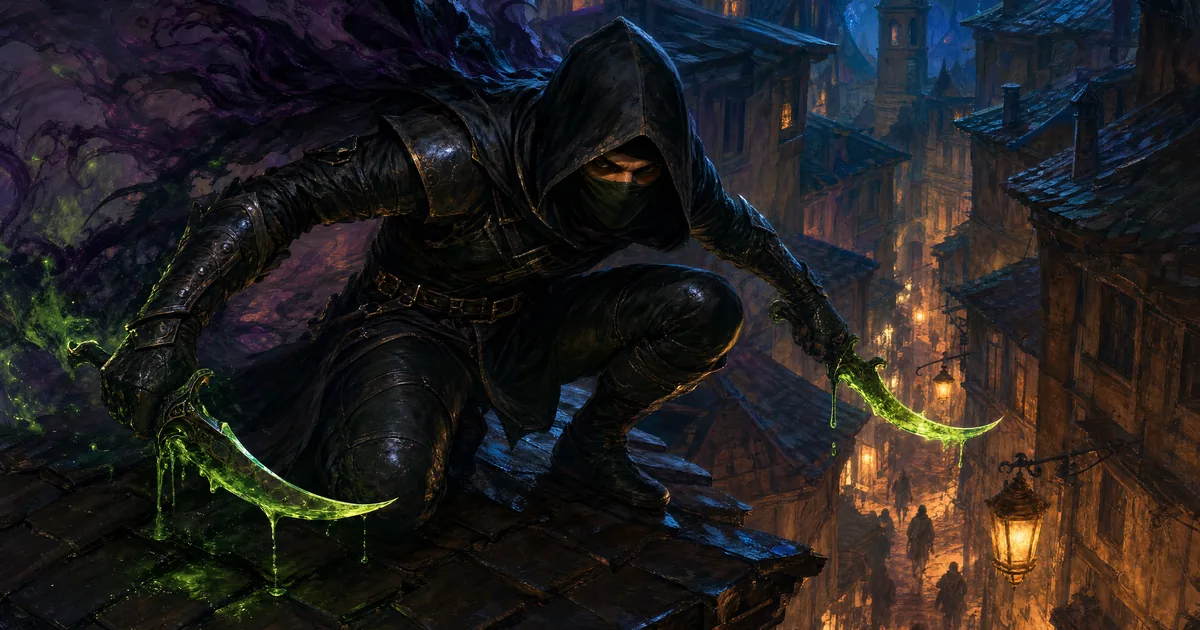
Rogue guide for the card MMORPG Zarhold: a dual-wielding damage dealer in leather, poisons and finishers, key cards, talent trees and PvE and PvP tips.
The Rogue is a damage dealer in leather with two blades. Their damage comes from poisons and bleeds that tick every turn, debuffs that make the target take more damage, and heavy finishing blows. A Rogue can’t tank or heal, but they ramp up their turn quickly and know how to take an opponent’s turn away. In this guide we’ll cover how to play a Rogue: their cards and Class Power, which talent trees to take early on and at level 60, what to wear and how to play in dungeons, raids and the arena.
The Rogue at a glance
- Group role: damage dealer.
- Armour: leather; cloth can be worn too.
- Resource: Energy. It’s the same Crystals everyone has: 1 on your first turn, one more each turn up to 10, and whatever you don’t spend is lost.
- Health at level 60 without gear: 457 — more than the cloth classes, less than the plate wearers.
- Cards: 21 of their own and 3 more from talents — one in each tree.
- Difficulty: medium. The deck forgives few mistakes: the order of debuffs, poisons and strikes matters.
Strengths and weaknesses
Strengths:
- a fast turn ramp: a 1-Crystal strike returns 4, and the cleanse returns another 2;
- damage over time: two bleeds, a poison and a poisoned strike;
- two debuffs that make the target take 20% and 25% more damage;
- two cards that make the enemy lose a turn;
- the attacking Class Power halves the target’s healing — in every tree;
- 14 talents per tree — more than any other class, so plenty of room for your own build.
Weaknesses:
- a single role — in a group the Rogue is always a damage dealer;
- little defence: two small shields, a self-heal and a strike that heals;
- only one card hits all enemies — the Rogue is weaker against a crowd than against a single target;
- no shield and no two-handed weapons.
The Rogue’s deck: key cards
In Zarhold you don’t build your deck by hand: all 21 class cards and the cards of your learned talents go into battle, and if you have fewer than thirty cards the deck is topped up with copies of cheap ones. Every card with its description is in the Rogue’s Spellbook. Here’s what the class is built on.
Tempo
A 1-Crystal strike deals a little damage and returns 4 Crystals. The draw card draws 2 cards and returns 1 Crystal, and the card that removes harmful effects from you (debuffs, curses, bleeds) returns another 2. By the second or third turn a Rogue can play cards that are usually still out of reach.
Debuffs
Two cheap 2-Crystal strikes put a debuff on the target: for 3 turns it takes 20% or 25% more damage from all sources. Put them down before your heavy strikes and bleeds.
Poisons and bleeds
Two bleeds and a poison deal damage right away and again at the end of each of the enemy’s turns for 3 turns. A 6-Crystal strike hits hard and also poisons the target for 2 turns.
Control
Two 4-Crystal cards — a blinding one and a stunning one — make the enemy lose a turn. After a stun the target has at least 2 turns of their own when they can’t be stunned again, so keep the second control card for later.
Strikes and finishers
Direct strikes for 2, 4 and 5 Crystals and a 7-Crystal finisher. A buff adds 30% to your damage for 3 turns — put it up before a run of strikes. One card hits all enemies — for 5 Crystals it throws knives at every enemy on the field.
Defence
Two shields (12 and 10 base), a self-heal for 10 and a strike that also restores your Health. Base card numbers grow with Power: the more a card costs, the bigger the share of Power it gets.
The Rogue’s Class Power
Your Class Power is the round button that costs 1 Crystal, once per turn. The Rogue has the same power in all three trees: a strike after which the target receives half healing for 2 turns. It’s the Rogue’s main answer to healers and to enemies that heal themselves. The power’s numbers are in the Class Power reference.
Rogue talents: three trees
Talents unlock at level 10 and you get a point for every level — 51 by level 60. Each row of a tree opens for every 5 points in it, and the top talent — the tree’s final talent — needs 20 points in its own tree. A hero can only have one top talent per loadout. Each Rogue tree holds 14 talents, with 33, 34 and 33 ranks — 100 in total. Some talents reward a combo — specific cards played one after another.
- The first tree — the master of poisons and bleeds. Strengthens poisons and bleeds. Its 2-Crystal talent card strikes and then deals damage at the end of each of the enemy’s turns for 4 turns. Top talent: attacks against a target under the deadly poison deal 15% more damage.
- The second tree — the tempo duellist. Makes the cheap strike cheaper, strengthens the draw card, the strike on all enemies and the finisher, and adds Health. Its 1-Crystal talent card adds 40% to your damage for 2 turns. Top talent: the first 7-Crystal finisher of each fight deals 35% more damage.
- The third tree — control and tricks. Strengthens surprise strikes, control cards, shields and debuffs, and adds Health. Its 1-Crystal talent card adds 20% to your damage for 2 turns and puts up a small shield. Top talent: the draw card returns the cleanse to your hand, and after the cleanse your next attack deals 20% more damage.
The talent cards sit in the third row of the first and third trees (level 20 at the earliest) and in the fourth row of the second (level 25). Every tree with its talent and rank counts is in the Talent trees reference.
What to take early on
The Rogue has just one Class Power, so pick a tree by style: poisons and bleeds — the first, quick strikes and finishers — the second, control and tricks — the third. For solo quests the first is handy: damage over time keeps working while you play other cards. Put your points into one tree in a row — that opens the next rows and the talent card faster.
A level 60 build
- 21 points in the main tree: 20 to reach the top talent plus the top talent itself;
- the other 30 into Power and Health bonuses and upgrades to the cards you play most from the neighbouring trees.
The Rogue has more talents than anyone — 100 ranks for 51 points — so there are many possible builds. From level 20 a hero has two specialisations: one is handy for dungeons and raids, the other for the arena. Switching specialisations, loadouts and talent resets are free. How to count points and put a build together is covered in “Talents in a card RPG”. You can test a new build right away: the Try out button in the talents window takes you to the training dummy with its damage meter.
Rogue gear and weapons
- Armour: leather. You can also wear cloth, but your own type gives more protection.
- Weapons: dagger, sword, axe, mace, fist weapon and bow.
- Off hand: no shield, tome or orb — the off hand is for a second blade.
- Two-handed: none — one-handed weapons only.
- Two weapons: yes. Hands are equal for every class: two one-handers carry as many stats as another class’s two-hander.
At level 60 the Rogue’s goal is the Tier 1 set Shroud of the Moonless Alley: eight pieces of item level 232 from heroic raids and world bosses. The 2-, 4-, 6- and 8-piece bonuses depend on your active tree and don’t work in PvP. Details are in “Tier sets in an MMORPG”, and every class’s armour and weapons are in the Armour and weapons reference.
Which race to choose for a Rogue
Any race can be a Rogue. A damage dealer values Power most — it strengthens both strikes and poisons: the Kogran, Nakar and Shaydar get +6% Power each, the Velion +5%, the Selenar +3% Power and −3% damage taken. If you need more toughness, the Gartan get +10% Health and the Durgar +8%. For the arena, consider the Morven: no crowd control makes them lose a turn — while stunned they simply have 1 Crystal. Every bonus is in the All races reference.
The Rogue in PvE: dungeons and raids
A dungeon takes a tank, a healer and a damage dealer; a raid or a world boss takes a tank, a healer and three damage dealers. The Rogue fills a damage slot.
- Debuff first. Under it the target takes more damage from you and from the whole party.
- Don’t pull the boss. A boss attacks whoever has dealt it the most damage. Damage over time creates no threat, so poisons and bleeds add damage without taking the boss from the tank. Watch the enemy’s targeting line on the board: with 457 Health, a boss’s heavy hits are not for the Rogue.
- Finishers under the buff. Play the +30% buff and follow it straight away with expensive strikes.
- Don’t drag the fight out. If a fight lasts longer than it’s meant to, the boss enrages: every stage adds 18% to its damage.
How boss fights work is in the knowledge base article Boss fights, and step-by-step raid prep in “Your first MMORPG raid”.
The Rogue in PvP: arena and duels
In the arena (1v1, 2v2, 3v3 and 5v5), on the battleground and in duels the Rogue is dangerous through tempo, control and cutting healing.
- Class Power against healers. The power’s strike halves the target’s healing for 2 turns — use it on whoever is being healed.
- Control at the right moment. Take your opponent’s turn away when they have a strong turn ready. After a stun the target has at least 2 turns of their own when they can’t be stunned again.
- The cleanse removes debuffs, curses and bleeds from you and returns 2 Crystals. You can’t play cards while stunned — use the cleanse before, not after.
- Remember the PvP rules: you can’t lose more than 60% of your Health in a round (damage over time counts too), so no one dies in a single turn; from your 10th turn healing and shields weaken by 10% a turn, a card shield lasts 2 turns and can’t exceed 30% of your Health, and the deck isn’t reshuffled — once you run out of cards, fatigue damage begins. The Rogue cycles the deck quickly, so count your cards.
- Defence in PvP is Resilience from PvP gear; Hardiness from regular gear doesn’t work in the arena.
All the rules are in the knowledge base article Special PvP combat rules, and modes and ratings in “PvP in a card game”.
Common beginner mistakes as a Rogue
- Attacking without a debuff. For 2 Crystals a debuff gives +20–25% to all damage on the target for 3 turns — play it before the heavy strikes.
- Saving up Energy. Crystals don’t carry over to the next turn. The strike that returns 4 Crystals is there to let you play more right now.
- Waiting for an “ambush from the shadows”. The Rogue has no stealth in combat: the cleansing card removes harmful effects from you and returns 2 Crystals — that’s all it does.
- Wasting control. After a stun the target is immune to it for 2 of their turns.
- Wearing Hardiness gear in the arena. In PvP only Resilience protects you.
Rogue FAQ
Can a Rogue tank or heal?
No. The Rogue is a pure damage dealer: in a group they always take a damage slot, and the healing in their deck is for themselves only.
Which Rogue tree is best?
The Class Power is the same in every tree, so it’s a matter of style: poisons and bleeds, quick strikes with a finisher, or control and tricks. Talent resets are free — try each of them on the training dummy.
Does the Rogue have stealth?
No. Zarhold’s combat has no invisibility: the cleansing card removes harmful effects from you and returns 2 Crystals, and the third tree’s top talent makes your next attack after it 20% stronger.
What weapons does a Rogue use?
Dagger, sword, axe, mace, fist weapon and bow — one-handed only. The Rogue wields two weapons; shields and other off-hand items aren’t available.
How much Health does a Rogue have?
457 at level 60 without gear. That’s more than the Priest, Mage and Warlock but less than the plate wearers — which is why in a group the Rogue shouldn’t pull the boss.
The bottom line
The Rogue is the pick for anyone who loves fast tempo and precise calculation: weaken the target, lay down poisons, take the opponent’s turn away and finish with a decisive blow. Start with the tree that suits your style, take it to the top talent by level 60, and keep the second specialisation for the arena. Create a Rogue and see how fast you can ramp a turn. And if you’re still choosing a class, see “Which class to choose”.
Read next
Which class to choose: tank, healer or damage dealer in a card MMORPG
Which class to choose in the card MMORPG Zarhold: what tanks, healers and DPS do, how the 10 classes differ, their armour and Health, talents and races.
Talents in a card RPG: the tree, specialisations and a build for every role
The talent tree in Zarhold: 51 points by level 60, rows and top talents, two specialisations, loadouts and how to build for solo, groups and the arena.
PvP in a card game: a 1v1 to 5v5 arena and battlegrounds
How PvP works in the card MMORPG Zarhold: 1v1, 2v2, 3v3 and 5v5 arena, two battleground modes, rating, seasons, rewards and the Resilience stat.