Mage guide: how to play a glass-cannon caster — talents, build, PvE and PvP
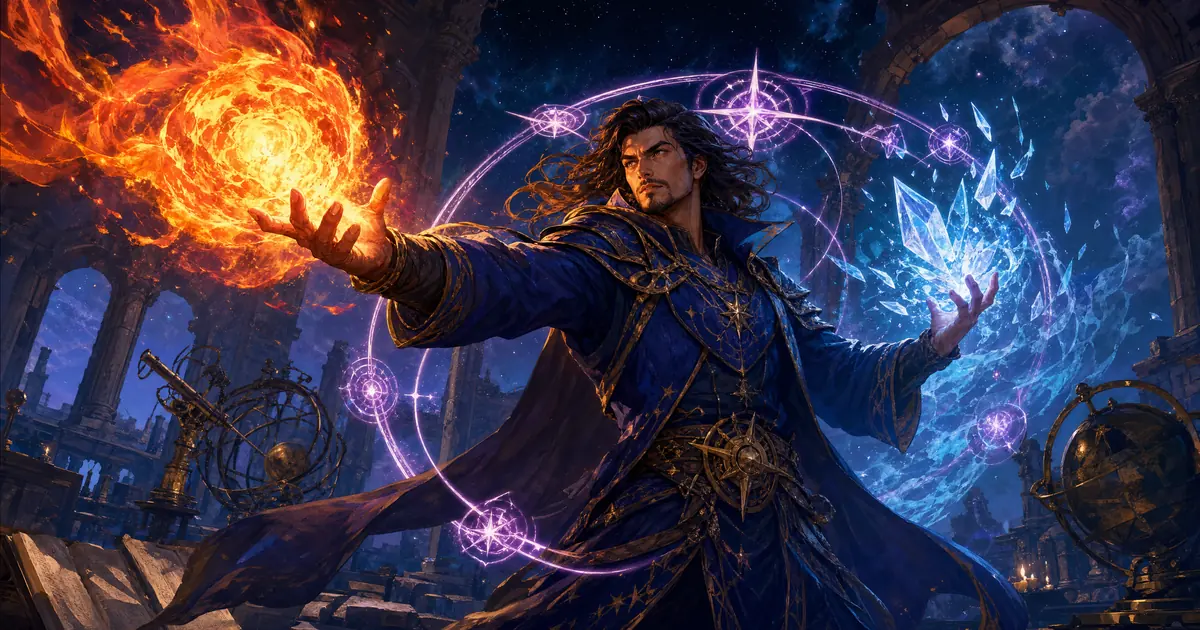
Mage guide for the card MMORPG Zarhold: burst damage and control in cloth, key cards, three talent trees, weapons and gear, tips for raids and the arena.
The Mage is Zarhold’s classic glass cannon: the lowest Health in the game and very powerful turns. The Mage freezes and polymorphs enemies, makes them vulnerable and unloads as much damage in one turn as others deal in two. If you like counting turns ahead and picking the perfect moment to strike, this is your class. Here’s how to play a Mage: cards and Class Power, talent trees early on and at level 60, gear, and how to play in dungeons, raids and the arena.
The Mage at a glance
- Group role: damage dealer only.
- Armour: cloth.
- Resource: Mana. It’s the same Crystals everyone has: 1 on your first turn, one more each turn up to 10, and whatever you don’t spend is lost.
- Health at level 60 without gear: 331 — the lowest in the game, almost half the Barbarian’s 632.
- Cards: 20 of their own — fewer than any other class — and 3 more from talents, one in each tree.
- Difficulty: above average. Low Health and no healing make mistakes costly, but a well-planned turn decides the fight.
Strengths and weaknesses
Strengths:
- burst damage: +30% and +50% damage buffs, plus debuffs that make the target take more damage;
- control: two cards that make the enemy lose a turn;
- three shield cards, one of them only 2 Crystals;
- a choice of Class Power: each of the three trees has its own attacking power, including one that hits all enemies;
- two strikes on all enemies plus damage over time — the Mage handles groups of enemies too.
Weaknesses:
- the lowest Health in the game and the lightest armour;
- not a single healing card in the deck — survival rests on shields and control;
- one role only — damage; the Mage can’t tank or heal;
- the fewest cards, so the deck is topped up with copies of cheap cards more often.
The Mage’s deck: key cards
All 20 class cards and the cards of your learned talents go into battle; if you have fewer than thirty, the deck is topped up with copies of the cheapest ones. Every card with its description is in the Mage’s Spellbook. Here’s what the class is built on.
Frost: vulnerability and control
- a cheap frost strike for 2 Crystals;
- a cheap frost spell for 2 Crystals: a little damage, and the target takes 40% more damage from all sources for 2 turns;
- another frost spell: damage, and the target takes 20% more damage for 3 turns;
- a deep freeze: damage and a lost turn;
- a frost strike on all enemies for 5 Crystals.
Fire: strikes and burning
A fire orb for 4 Crystals, a burn that deals damage at the end of each of the enemy’s turns for 3 turns, a “living bomb” with the same kind of damage over time, a pillar of flame on all enemies and the Mage’s big 8-Crystal finisher, which sets the target on fire too.
Arcane and tempo
- a heavy arcane strike for 4 Crystals and a swarm of missiles that keeps dealing damage for 2 turns;
- a card that draws 2 cards and returns 1 Mana;
- a 1-Crystal dash: removes harmful effects from you and returns 2 Mana (on an ally it removes harmful effects except those that take away a turn);
- a polymorph: the enemy loses their turn.
Buffs and defence
Two buffs: +30% damage for 3 turns and +50% for 2 turns. Three shields — 18 base (for 2 Crystals), 14 and 20. Base card numbers grow with Power: the more a card costs, the bigger the share of Power it gets.
The Mage’s Class Power
Your Class Power is the round button that costs 1 Crystal, once per turn. The Mage is the only class where every tree gives its own attacking power:
- the first tree (and no specialisation, before level 10) — a strike on the target;
- the second tree — a strike on the target, and at the end of the enemy’s turn more damage to all enemies;
- the third tree — a strike on the target that scales hardest with Power: at 306 Power (a full blue level 60 set) it deals 177 damage versus the first tree’s 119.
The numbers for every power are in the Class Power reference.
Mage talents: three trees
Talents unlock at level 10 and you get a point for every level — 51 by level 60. Each row of a tree opens for every 5 points in it, and the top talent needs 20 points in its own tree; a hero has only one top talent per loadout. The Mage’s trees hold 22, 24 and 22 ranks — 68 in total.
- The first tree — frost and control. Talent card: a strike for 4 Crystals after which the target takes 30% more damage for 2 turns.
- The second tree — burning. Talent card: a strike on all enemies for 5 Crystals with damage over time for 2 turns.
- The third tree — tempo and card draw. Talent card: a cheap 2-Crystal strike that also draws a card.
The talent cards sit in the third row of their trees: level 20 at the earliest. Every tree is in the Talent trees reference.
What to take early on
Any tree works for open-world quests: the Mage’s Class Power attacks in all three. If you often fight several enemies at once, the second tree is handy — its power hits them all. Put your points into one tree in a row so the next rows and the talent card open faster.
A level 60 build
From level 20 a hero has two specialisations. The Mage uses them not for different roles but for different jobs:
- Spec A — the tree whose power hits all enemies, for fights against groups;
- Spec B — the tree with the strongest single-target power, for long fights against one target and for the arena.
Put 21 points into your main tree (20 to reach the top talent plus the top talent itself) and the other 30 into bonuses from the neighbouring trees and the talent cards you need. Switching specialisations, loadouts and talent resets are free; how to build is covered in “Talents in a card RPG”. The easiest way to compare trees is the training dummy: the Try out button in the talents window plus the damage meter show the difference in numbers.
Mage gear and weapons
- Armour: cloth — the Mage wears nothing else.
- Weapons: staff, sword, dagger or wand.
- Off hand: tome or orb.
- Two-handed: staff. The Mage doesn’t wield two weapons — but hands are equal for every class: a one-hander plus a tome or orb carry as many stats as a staff.
At level 60 the Mage’s goal is the Tier 1 set Mantle of the Starry Vault: eight pieces of item level 232 from heroic raids and world bosses. The 2-, 4-, 6- and 8-piece bonuses depend on your active tree and don’t work in PvP. Details are in “Tier sets in an MMORPG”, and every class’s armour and weapons are in the Armour and weapons reference.
Which race to choose for a Mage
Any race can be a Mage. Pick the race’s permanent bonus by what you’re missing:
- more damage — Power: the Kogran, Nakar and Shaydar get +6% each, the Velion +5%, the Selenar +3% Power and 3% less incoming damage;
- more toughness — Health: the Gartan +10%, the Durgar +8%, the Grumak and the Vaerin +5% each;
- for the arena — the Morven: no crowd control makes them lose a turn; while stunned they simply have 1 Crystal.
Every bonus is in the All races reference.
The Mage in PvE: dungeons and raids
A dungeon takes a tank, a healer and a damage dealer; a raid or a world boss takes a tank, a healer and three damage dealers. The Mage fills a damage slot.
- Don’t pull the boss off the tank. A boss attacks whoever has dealt it the most damage. The tank’s Taunt holds it for 2 turns and the tank’s damage makes triple threat — but if you unload everything in the first turns, the boss may turn on you. With 331 Health that’s dangerous. The board shows who every enemy is targeting.
- Vulnerability first. Play the card that makes the target take more damage first, then the expensive strikes: they’ll hit harder.
- Keep a shield ready. Hits on “everyone” strike the whole group, and no taunt saves you from them. A cheap 2-Crystal shield is often worth more than one more strike.
- Control the dangerous ones. You can take an enemy’s turn away too, but after a stun the target has 2 turns of their own when they can’t be stunned again.
- Shorter fight, less risk. A long fight is dangerous: the boss enrages, and every stage adds 18% to its damage.
Step-by-step prep is in “Your first MMORPG raid”, boss rules in the knowledge base article Boss fights.
The Mage in PvP: arena and duels
In the arena (1v1, 2v2, 3v3 and 5v5), on the battleground and in duels the Mage is a threat to any opponent — as long as you remember the PvP rules:
- The round cap. In one round — your turn and your opponent’s — nobody can lose more than 60% of their maximum Health. You can’t kill from full Health in one turn: plan your win over two rounds.
- Control. Two turn-skipping cards are the Mage’s main weapon, but after a stun your opponent has 2 turns of protection from the next one, and a Morven never loses a turn at all.
- Weaker shields. A card shield lasts 2 turns and can’t exceed 30% of your maximum Health, and from your 10th turn shields and healing weaken by 10% a turn.
- No reshuffle. Once your deck runs out, fatigue damage begins. Card-draw cards bring it closer: in a long fight, don’t draw more than you need.
- Defence in PvP is Resilience from PvP gear; Hardiness from regular gear doesn’t work in the arena.
All the rules are in the knowledge base article Special PvP combat rules, and modes and ratings in “PvP in a card game”.
Common beginner mistakes as a Mage
- Unloading everything in the first turns of a group fight. The boss goes to whoever has dealt the most damage — let the tank settle in.
- Playing vulnerability after the strike. A debuff boosts the next strikes, not the previous ones.
- Buffing damage with no strikes in hand. +50% lasts only 2 turns — make sure you have something to boost first.
- Forgetting shields. There’s no healing in the deck and the lowest Health in the game.
- Wearing Hardiness gear in the arena. In PvP only Resilience protects you.
Mage FAQ
Is the Mage good for beginners?
Yes, but it’s stricter than other classes: the lowest Health and no healing. On the other hand, damage and control let you end fights quickly. If you want some breathing room early on, pick a race with a Health bonus.
Can a Mage heal or tank?
No. The Mage is a damage dealer only: there’s no healing in the deck and no Taunt in any tree. Shields, control and fast damage keep the Mage alive.
Which Mage tree is the strongest?
It depends on the job. The second tree’s power hits all enemies, which is handy against groups. The third tree’s power scales hardest with Power on a single target. Compare them on the training dummy: the damage meter will show the difference.
Why does my Mage’s deck have repeated cards?
The Mage has 20 class cards — fewer than anyone — and a deck is never smaller than 30. The rest is topped up with copies of the cheapest cards, no more than four of the same card.
What weapons does a Mage use?
Staff, sword, dagger or wand, plus a tome or orb in the off hand. The Mage doesn’t use two weapons or a shield.
The bottom line
The Mage is a class for anyone who loves big numbers and precise planning: freeze, apply vulnerability, unload a strike — and the fight is over. The price is fragility, so a good Mage always keeps a shield and control at hand. Create a Mage and see how much damage you can squeeze out of a single turn. And if you’re still choosing a class, see “Which class to choose”.
Read next
Which class to choose: tank, healer or damage dealer in a card MMORPG
Which class to choose in the card MMORPG Zarhold: what tanks, healers and DPS do, how the 10 classes differ, their armour and Health, talents and races.
Talents in a card RPG: the tree, specialisations and a build for every role
The talent tree in Zarhold: 51 points by level 60, rows and top talents, two specialisations, loadouts and how to build for solo, groups and the arena.
PvP in a card game: a 1v1 to 5v5 arena and battlegrounds
How PvP works in the card MMORPG Zarhold: 1v1, 2v2, 3v3 and 5v5 arena, two battleground modes, rating, seasons, rewards and the Resilience stat.