Arena rating and the Hall of Fame: calibration, seasons and rewards
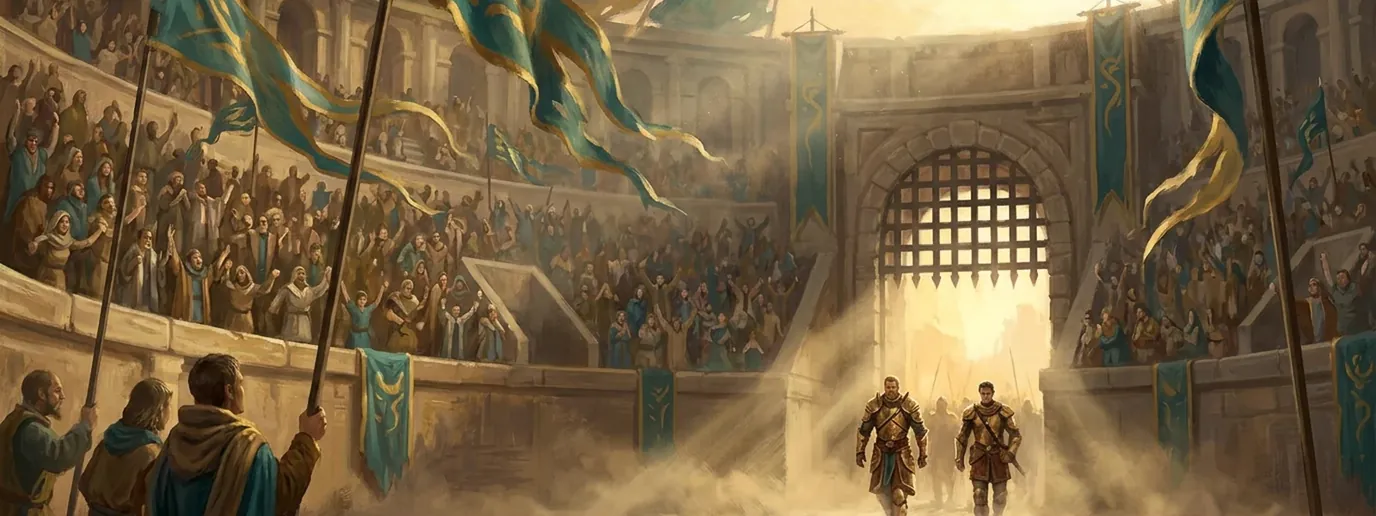
How arena rating works in Zarhold: Elo and calibration, matchmaking below 60, the arena season and reset, titles, rewards and the Hall of Fame.
Arena rating is the main measure of strength in Zarhold PvP: it puts you on the leaderboard, decides who you get matched with and hands out the season rewards. Let’s break down how the PvP ranking and rating calibration work, how the 1v1 ladder differs from the 2v2, 3v3 and 5v5 arena, what happens when an arena season ends — and why the Hall of Fame is the one table no season ever wipes.
If you’re not sure yet which PvP modes the game has, start with “PvP in a card game”. Here we go deeper — into the numbers.
How arena rating is calculated
Rating uses the Elo system. Every new fighter — and every fighter at the start of every season — begins at 500. The rating step is 32: that’s the most you can win or lose in one fight. How much you actually get depends on how much stronger or weaker your opponent is:
- an equal opponent — +16 for a win and −16 for a loss;
- an opponent 200 above you — +24 for a win and only −8 for a loss;
- an opponent 400 above you — +29 and −3;
- an opponent 200 below you — a win gives +8, while a loss costs −24.
Two important details. A win always gives at least +1 — even against someone far below you on the ladder. And there’s no rating cap: keep winning and the number keeps climbing. Only wins and losses move it — the number of fights you play adds nothing on its own.
Team fights
In 2v2, 3v3, 5v5 and on the battleground every fighter has their own rating, calculated with the same formula — just against the average rating of the enemy team. So the same win pays teammates differently: if the enemy team averages 600, a fighter at 500 gets +20, while a teammate at 700 gets only +12.
Rating calibration: the first 10 fights of a season
Your first 10 fights of a season on each ladder use a step of 48 instead of 32. Against an equal opponent that’s ±24, and beating someone 200 above you is worth +36 instead of +24. Calibration exists so that a newcomer or a returning player reaches their real place quickly instead of grinding up for weeks.
- Each ladder counts calibration separately: 1v1, 2v2, 3v3, 5v5 and the battleground calibrate on their own.
- The step is personal. If you’re calibrating and your opponent isn’t, their rating changes by the normal step.
- The arena shows how many fights are left right on screen: “Calibration: N / 10 — rating moves faster”.
- When a new season starts, calibration begins again in every mode.
The practical takeaway is simple: the start of a season is the best time to play a lot. Every calibration win is worth half as much again as a normal one — and so is every loss.
Ladders and tiers: where you have a rating of your own
A hero doesn’t have one rating but a whole set. The arena has four formats — 1v1, 2v2, 3v3 and 5v5 — plus one more ladder for the battleground (a single rating for both its modes). A 3v3 win doesn’t move the 1v1 table, and vice versa.
On top of that, the ladders are split into two tiers by level:
- 1–59 — the rising tier, for heroes who are still levelling;
- 60 — the top tier: level 60 heroes only ever meet each other.
You can enter the arena from level 1, and manual fights are unlimited. How to get into each format and how the battleground modes differ is covered in the knowledge base article “Arena: 1v1, 2v2, 3v3 and 5v5 fights”.
Matchmaking: level and a ±20 rank window
The arena picks your opponent using two measures. Level decides who can be matched at all, and rating decides which of them is closest to you in strength.
- Level. Below 60, your opponent is never more than ±6 levels away: a level 30 hero meets fighters from level 24 to 36. The window never widens beyond that.
- Rating. Everyone on your tier is lined up by rating, and your opponent is picked at random from the 20 ranks above and 20 ranks below you.
- No repeats. Your last 10 opponents are skipped; a rematch only happens if there’s nobody else to pick.
- Filling the gap. If there are few heroes in your level window, your opponent will be a world resident near your level — with their own gear, talents and deck.
Matchmaking goes by rating, not by gear, so a hero in a full PvP set can easily sit right next to you on the ladder. The upside: beating them is worth more.
In 2v2, 3v3, 5v5 and on the battleground, if you queue alone the fight starts right away and world residents fill the free seats on both teams. A live party first spends 45 seconds looking for a live enemy party of a suitable level, and only then fights residents. For a party, the level window is measured from its average level.
There’s also some relief while you’re learning: heroes of level 1–59 with a mode rating of 1,000 or less never face an opponent above their own level, and residents show up in ordinary PvE gear no better than blue. Details in “How arena opponents are matched”.
The arena season: 60 days and a reset to 500
PvP in Zarhold runs in seasons. An arena season is designed to last 60 days; the Season tab shows how much time is left. When a season closes:
- Final standings are saved to an archive, also visible on the Season tab.
- The best players get rewards based on the 1v1 table — separately for the 1–59 tier and the 60 tier. Places are counted among players’ heroes only: world residents get no season places or rewards.
- Rating in every mode — every arena size and the battleground — returns to 500.
- The Honor Circle, the separate duel rating, is settled too; more in “Duels in an MMORPG”.
It’s a full reset: everyone starts the new season from the same mark — last season’s champion and someone who logged in yesterday alike. Title thresholds don’t get any lower, though: Duelist at 1,800 is worth exactly the same every season.
Rating decay when you don’t play
So that a high rating doesn’t stay frozen for someone who stopped playing, the 1v1 table has decay. If your 1v1 rating is above 500 and you haven’t played a single 1v1 fight for 7 days, it slides down by 5% of the distance to 500 on your next arena visit — at most once every 7 days and never below 500. A rating of 1,500 becomes 1,450 after an idle week. One 1v1 fight restarts the clock.
What a season doesn’t touch
The reset only affects rating. You keep your PvP gear, Arena Points and Honor, duelist marks, titles and achievements. An unlocked achievement stays forever — even after the rating that earned it has been reset.
Season rewards and rating titles
Your season reward depends on your place in the 1v1 table of your tier:
- 1st place — the Season Trailblazer title, the Champion’s Brand, the Champion Laurel portrait frame and 5,000 Arena Points;
- 2nd–3rd — the Duelist title, the Runner-up’s Brand, the Podium Laurel frame and 3,000 Arena Points;
- 4th–10th — the Fighter’s Brand, the Arena Iron frame and 1,500 Arena Points;
- 11th–30th — the Arena Season card back and 500 Arena Points;
- below 30th — 100 Arena Points for everyone who played at least one fight.
Brands are turquoise unique items bound to your account. Once per fight a brand removes everything harmful from your hero, stuns included (you can press it while stunned), and puts up a shield — in the arena and in fights against creatures alike. Rewards are handed out once the season is closed: you get a letter about them and collect the reward on the Season tab. The full table is in the “Season rewards” reference.
Beyond season rewards, rating unlocks permanent achievements — in steps from Contender at 1,200 to Merciless at 2,500, and rating in any mode counts. 1,800 grants the Duelist title, 2,500 the Merciless title, and 25 wins in a row at a rating of 2,100 or higher earns Indomitable. The peak of PvP is the Merciless Gladiator achievement: a 2,500 rating, that 25-win streak and 500 wins overall; its reward is a legendary cloak. Every condition is listed under Achievements.
The Hall of Fame: the one thing that never resets
Arena rating starts over every 60 days. The Hall of Fame is the opposite — it’s forever. It isn’t a PvP table but a record of the first heroes to reach level 60:
- the first on the server to reach 60 gets the Realm First title;
- the first three of each class get the First, Second and Third titles for their class — for example, Second Rogue of the Realm.
Every new place is announced in World chat, the hero gets a congratulatory letter from the Game Master, and their name is written into the Hall of Fame on the website, in the Records section. If a class still has an open place, it says exactly that: “Place still open”.
The class rule is a fair one: a place in a class only goes to a hero who reached 60 as that class from the very start. Change class before 60 and there’s no class place for you — neither in the new class nor in the old one. If a hero changes class after earning a place, the place stays with the class they earned it as, and their current class is shown next to it.
More about titles and the Hall of Fame in the knowledge base article “Achievements, titles and the Hall of Fame”.
Ratings on the website
Every ladder is open not only in the game (the Ladder tab in the arena) but also on the website, in the Ratings section:
- mode switches: 1v1, 2v2, 3v3 and 5v5 arena, battlegrounds and the Honor Circle;
- the arena and battlegrounds have two tiers: Levelling and Level 60;
- each table shows up to the top hundred: place, hero with title, class, race, level, rating and fights played;
- clicking a row opens the hero’s Armory page, with all their gear and fight history.
It’s an easy way to see how the leaders of your tier are geared and which classes sit at the top right now.
How to climb the arena rating
- Play at the start of the season. During calibration a win is worth half as much again.
- Don’t dodge strong opponents. Beating someone 200 above you gives +24, while losing costs just −8.
- Build a PvP set. Resilience cuts damage from other players, and the PvP shop has gear from level 1. What to aim for at level 60 is in “Level 60 gear”.
- Keep a separate specialization. From level 20 a hero has two specializations: one for dungeons and quests, the other for the arena.
- Learn the PvP combat rules. You can’t lose more than 60% of your Health in one round, and healing and shields weaken from your 10th turn — “PvP combat rules”.
- Don’t vanish for long. After a week without 1v1 fights, a high rating starts to slide.
Arena rating FAQ
What rating does everyone start at?
500 — both a brand-new hero and every single player at the start of each season. The first 10 fights of a season in every mode use faster calibration: a step of 48 instead of 32.
Is there a cap on arena rating?
No. Your rating keeps rising as long as you win, and a win always gives at least +1 — even against a weak opponent.
Is 2v2, 3v3 and battleground rating reset too?
Yes. At the end of a season every mode goes back to 500. Season rewards, however, are handed out only for the 1v1 table — separately for the 1–59 tier and for level 60.
Will I lose my title when the season ends?
No. A season only resets rating; titles, achievements, PvP gear, Arena Points and Honor all stay with you.
How do I get into the Hall of Fame?
Be the first hero on the server to reach level 60, or one of the first three of your class — and reach 60 as that class from the very start. A place, once taken, stays with the hero forever.
The bottom line
Arena rating in Zarhold is transparent: Elo with a step of 32, calibration over the first ten fights, matchmaking within a ±20 rank window and a full reset every 60 days. Everything you earn in a season except the number itself stays with you, and the fastest heroes on the road to 60 stay in the Hall of Fame for good. Jump into the game, open the Arena and start your calibration.
Read next
PvP in a card game: a 1v1 to 5v5 arena and battlegrounds
How PvP works in the card MMORPG Zarhold: 1v1, 2v2, 3v3 and 5v5 arena, two battleground modes, rating, seasons, rewards and the Resilience stat.
Duels in an MMORPG: one on one, stakes and an honor rating
Duels in the card MMORPG Zarhold: challenge any hero to a fair fight, keep a permanent record, stake gold or items and climb the Honor Circle.
Level 60 gear guide: how to gear up your hero and raise your item level
How to gear up at level 60 in Zarhold: what item level (ilvl) means, where to get 200, 226 and 232 gear, enchants, sharpening and the way to the best gear.