What is an MMORPG? A simple explanation, examples and how it differs from an RPG
What an MMORPG is in plain words: what the acronym stands for, MMO vs MMORPG vs RPG, what makes the genre, examples of games and how to start playing free.
An MMORPG is an online role-playing game where thousands of people play at the same time in one shared world. You have your own hero: they level up, find gear and complete quests, and take on the hardest challenges together with other players. The world doesn’t disappear when you log off — it keeps going, and tomorrow you’ll come back to where you left off.
Below: what the acronym stands for, how an MMORPG differs from a plain MMO and from an RPG, what the genre is made of, what kinds there are and where to start.
What MMORPG stands for
MMORPG is short for Massively Multiplayer Online Role-Playing Game. Piece by piece:
- Massively Multiplayer — not 4 or 10 people, but thousands, all in one world;
- Online — the game runs over the internet, and the world is stored on a server rather than on your computer;
- Role-Playing Game (RPG) — you control a hero, develop them and make decisions for them.
People say it as “M-M-O-R-P-G”, “MMO-RPG” or just “MMO”. The term caught on in the late 1990s — it’s often credited to Richard Garriott, the creator of Ultima Online (1997).
MMO vs RPG vs MMORPG: what’s the difference
These words get mixed up a lot, but the difference is simple:
- RPG — a role-playing game. It can be single-player: a hero, a story, progression, but you’re alone in the world. Most RPGs are like this.
- MMO — any massively multiplayer online game: a strategy game, a shooter or a racing game. What matters is lots of players in a shared world.
- MMORPG — where the two meet: a role-playing game and a massive online world. You grow your hero like in an RPG, but there are real people around you to run dungeons with, trade with and fight.
- Online RPG or co-op RPG — somewhere in between: the game is online, but a few friends play together rather than thousands of people in one world.
So “MMO” is the broad word and MMORPG is its role-playing part. When people ask “what MMO should I play”, they usually mean an MMORPG.
What makes an MMORPG: the key features
Almost every MMORPG rests on the same pillars. If half of them are missing, it’s probably a different genre.
- A persistent world. It exists even when you’re offline: other players trade, run dungeons and grow.
- A hero who grows. Levels, abilities, gear, talents. Progress builds up over weeks and months.
- Classes and roles. There’s usually a tank (takes the hits), a healer (keeps the group alive) and damage dealers. The jargon is explained in the MMORPG glossary.
- Group challenges. Dungeons for a small group and raids for a bigger one, with tough bosses and valuable loot. More in dungeons and raids.
- PvP. Player-versus-player fights: duels, arenas, battlegrounds.
- An economy. Professions, gathering, an auction house, trading between players.
- A community. Chat, friends and guilds — groups of players who play together.
Types of MMORPG
By where you play
- On a PC with an install — big games with their own client that takes up tens of gigabytes.
- In a browser — the game opens in a tab, there’s nothing to install. More in “A browser MMORPG with no download”.
- On a phone — dedicated mobile apps, or games that open in your phone’s browser.
By how combat works
- Real-time — you press abilities quickly, dodge and watch the battlefield.
- Turn-based — players take turns, so there’s time to think. See “Turn-based RPG online”.
- Card-based — your hero’s abilities are cards in your hand, and every turn you decide what to play. That’s how Zarhold works: “Card MMORPGs: what they are”.
By how you pay
- Subscription — you pay monthly for access.
- Free to play with optional purchases — you can play for free, and the shop sells looks, convenience and boosts.
- Buy once — you pay for the game or its expansions, with no monthly fee.
MMORPG examples
The best-known MMORPGs that almost every gamer has heard of:
- World of Warcraft — Blizzard’s fantasy MMORPG, one of the best-known games in the genre;
- Final Fantasy XIV — a Japanese MMORPG with a focus on story;
- EVE Online — a space MMORPG where the economy and wars are run by players;
- Guild Wars 2 — a fantasy MMORPG with dynamic events in an open world;
- RuneScape — one of the oldest, which started out as a browser game in 2001.
If you want to know whether there are “lighter” MMORPGs — no download and no need for fast reflexes — have a look at “Best browser MMORPGs in 2026”.
What a typical evening in an MMORPG looks like
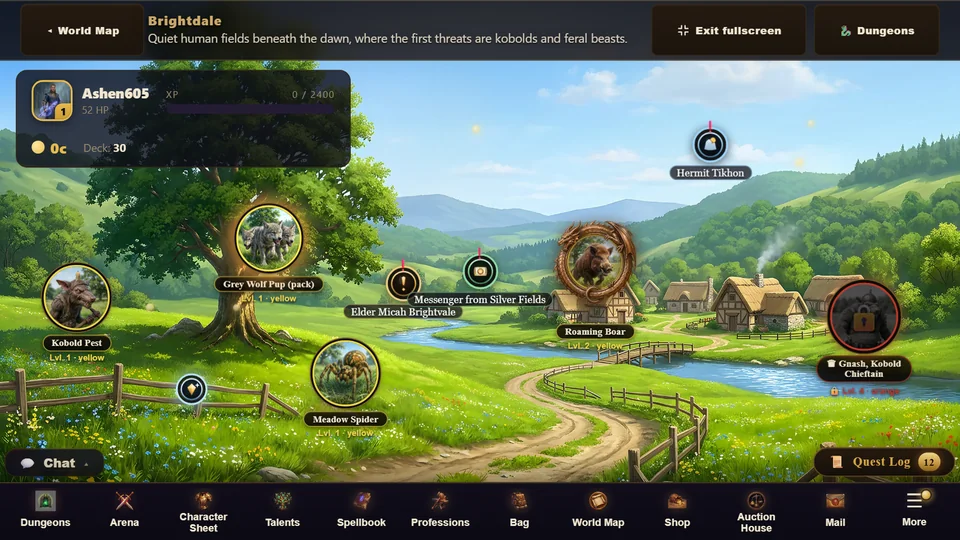
Let’s take our own game as an example — Zarhold, an MMORPG where you fight with cards. An evening might go like this:
- log in, pick up the errands of the day and finish a couple of quests in your land;
- queue for a dungeon — the group forms in a minute, and empty slots are filled by residents of the world;
- after the run, put the loot you don’t need on the auction house and turn the herbs you gathered into potions with your profession;
- end the evening with a couple of arena fights or a duel with a friend.
That’s the strength of the genre: there’s plenty to do, and everyone picks their own thing — some people only trade, some live in the arena, and some organise raids.
How to start playing an MMORPG
- Pick a game that fits you. How much time you have, what you play on, whether you like real-time or turn-based combat. Tips are in “MMORPG for beginners: how to pick your first”.
- Pick a class. If you like taking hits — tank; helping — healer; dealing damage — damage dealer. More in “Which class to choose”.
- Take your time. The first levels teach you the basics. Read the tips and the quests.
- Find people. Ask in chat and join a guild — it’s more fun and easier together.
- Don’t be afraid of mistakes. In most MMORPGs they can be fixed: talents can be reset and gear replaced.
Zarhold: an MMORPG you can jump into in a minute
If you want to try the genre without a long install, Zarhold is an easy way in. It’s a free MMORPG in your browser on a computer, tablet or phone, and it’s also on VK Play. It has everything described above:
- 10 classes and 11 races, levels 1 to 60, talents and two specialisations;
- 26 lands full of quests, 23 dungeons for three and 6 raids and 3 world bosses for five;
- PvP: a 1v1, 2v2, 3v3 and 5v5 arena, a battleground and duels;
- 12 professions, an auction house, mail and trading between players;
- guilds, friends and chat, and empty group slots are filled by residents of the world.
The main difference is combat: instead of a button bar your hero has a hand of cards, and every turn is a small puzzle. You can even start without signing up: the “Play without signing up” button takes you straight to creating a hero. The full tour is in the Zarhold review.
MMORPG FAQ
What does MMORPG stand for?
Massively Multiplayer Online Role-Playing Game. Put simply, a role-playing game where thousands of people play in one world.
What’s the difference between an MMO and an MMORPG?
An MMO is any massively multiplayer online game: strategy, shooter, racing. An MMORPG is an MMO where you control a hero and develop them, like in a role-playing game.
What’s the difference between an MMORPG and an RPG?
An RPG can be single-player: just you and the story. In an MMORPG the world is shared and persistent — there are real players around you to team up with, trade with or fight.
Are there free MMORPGs?
Yes, lots: you play for free and the shop has optional purchases. Zarhold is free too — in your browser and on VK Play.
Can you play an MMORPG solo?
In many, yes: quests and levelling can be done alone, and group content has queues. In Zarhold empty group slots are filled by residents of the world — more in “A solo-friendly MMORPG”.
Do you have to download an MMORPG?
No. There are browser MMORPGs that open right in a tab, including on your phone. Zarhold is one of them.
The bottom line
An MMORPG is a role-playing game in a big living world: your own hero, classes and roles, dungeons and raids, fights with other players, trading and guilds. To find out whether the genre is for you, you don’t have to install tens of gigabytes — open Zarhold in your browser and finish your first quests in a few minutes. And if you run into an unfamiliar word, check the MMORPG glossary.
Read next
MMORPG glossary: tank, healer, DPS, aggro, cooldown, wipe and other gamer terms
What tank, healer, DPS, aggro, taunt, cooldown, DoT, wipe, ilvl, roll and other MMORPG terms mean — in plain words, with examples from Zarhold.
MMORPG for beginners: how to pick your first and survive the first evening
Which MMORPG to pick as a beginner: 7 questions to ask, signs of a beginner-friendly game, a plan for your first days, common mistakes, why Zarhold helps.
Card MMORPGs: what they are and why a deck beats a hotbar
What makes a card MMORPG different and why a deck beats a button rotation — explained through Zarhold: your hand, crystals, talents and ten classes.